

- WONE Lighting
- Horticultural Lighting
- Applications
- Strawberries
Application · Strawberries
Strawberry lighting: day length and winter light
Strawberries answer to light in two ways. A faint red and far-red signal at night changes how the plant reads the season; photosynthetic light in the dark months adds growth. Each has its own hardware, hours and budget, and the cultivar decides which is worth it.
Why light
Why light matters for strawberries
Photoperiod lighting. A few µmol/m²/s of red and far-red is enough for the plant to read a long day. In Japanese forcing culture, growers extend the evening to a day length of about 12–13 hours, or light for 3–4 hours around midnight, to keep short-day cultivars from going semi-dormant in winter. In everbearing and day-neutral types long days can advance flowering; in June-bearing types they tend to favour runners.
Photosynthetic supplementation. Toplighting adds daily light in winter. It carries lit winter strawberry production in northern Europe, where daylight alone cannot sustain a winter harvest.
The cultivar decides. Responses differ between cultivars and production systems. A programme that works for one variety can delay or reduce flowering in another, so every project begins with a pilot on a few benches.
 Research targetsLiterature
Photoperiod lighting
- Working threshold at plant level
- ≥ 2 µmol/m²/s0.5–3 µmol/m²/s · PAR, at the darkest plant
- Night break
- 4 h per night
Photosynthetic supplementation
- Photoperiod
- 16 h12–18 h
- Supplemental PPFD
- 70–280µmol/m²/s
- Daily light integral
- 12–25mol/m²/day
Ranges reported in the literature. Cultivar, climate, crop stage and market move them; every project begins by agreeing the target for that crop and that house.
From leaf to fruit
One strawberry plant, leaf to fruit
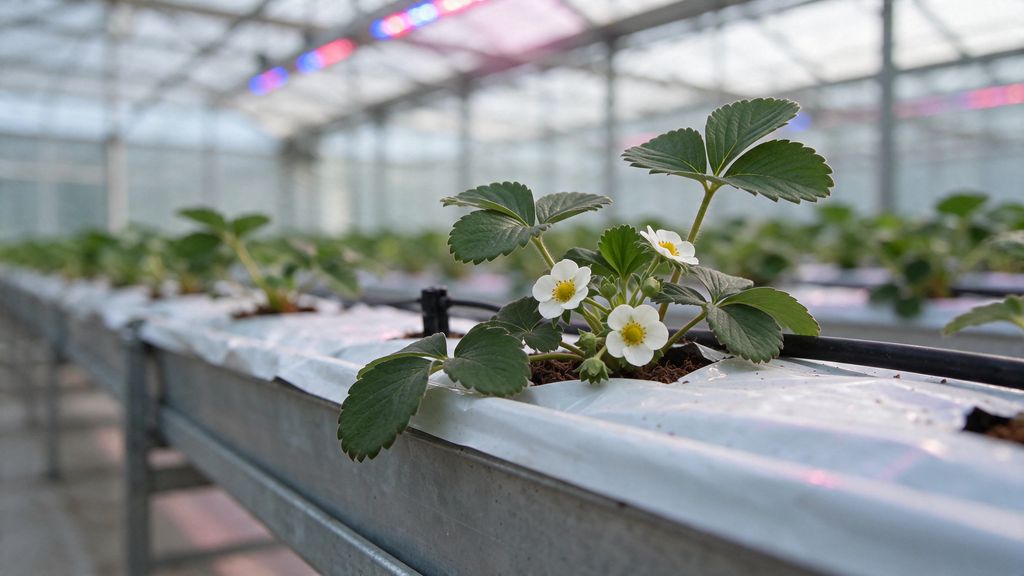
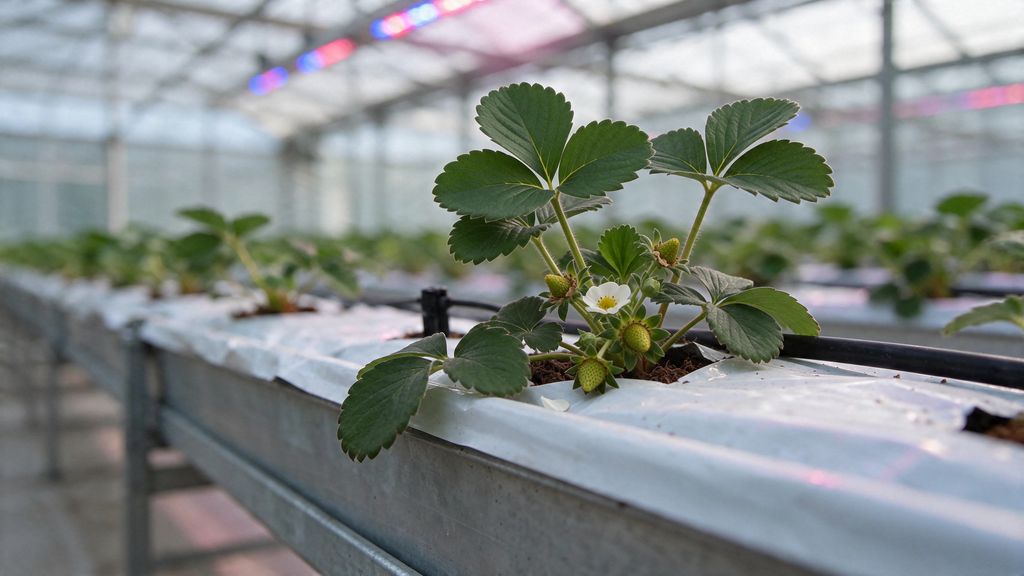
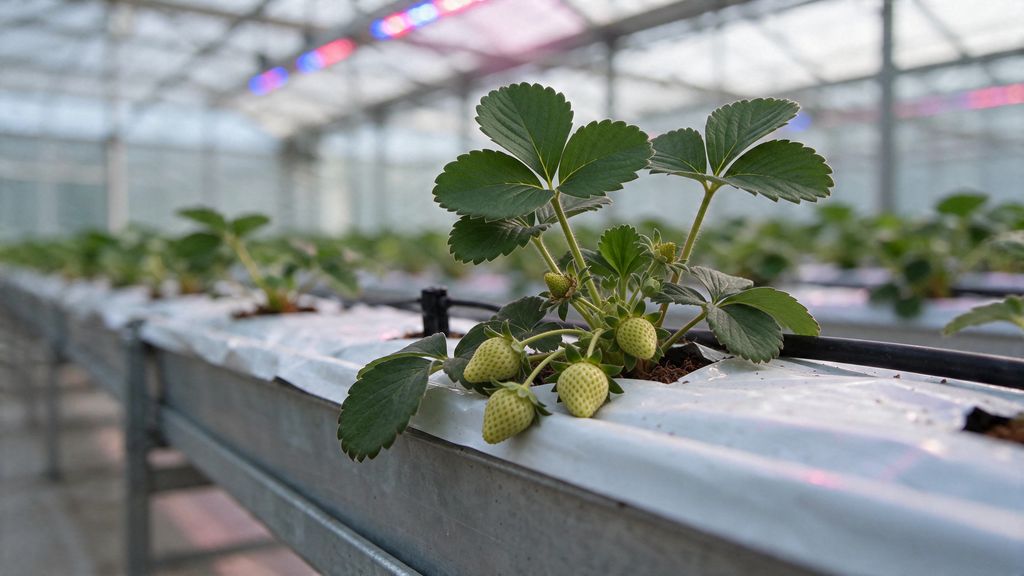
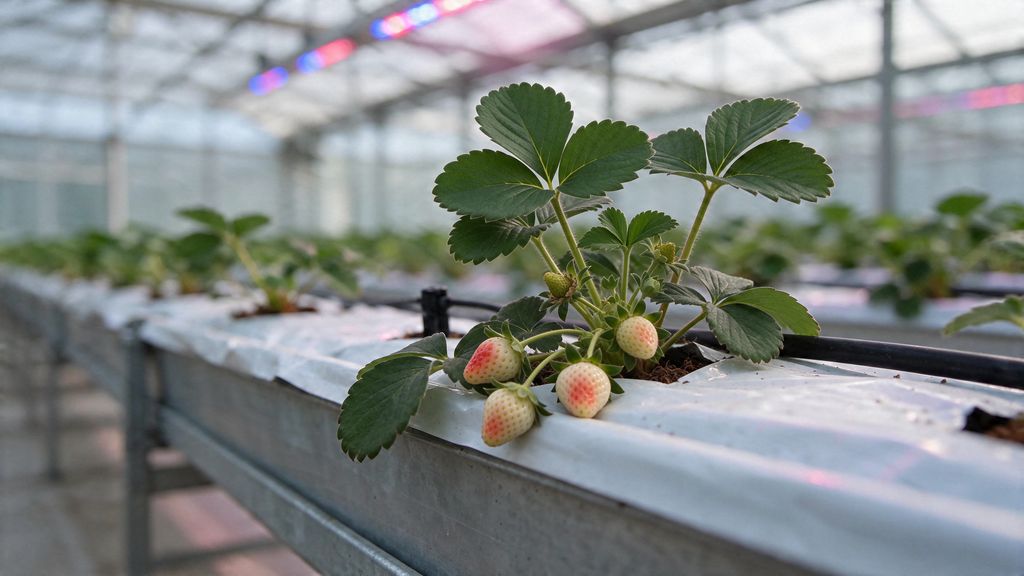
Eight stages of the same plant, from a new leaf to a ripe berry. Each stage asks something different of the light, so the schedule, the spectrum and the checks change with it. With plants that already carry flower buds, picking starts on average about 60 days after planting, and the fruit itself takes about 30 of those days.
Strawberries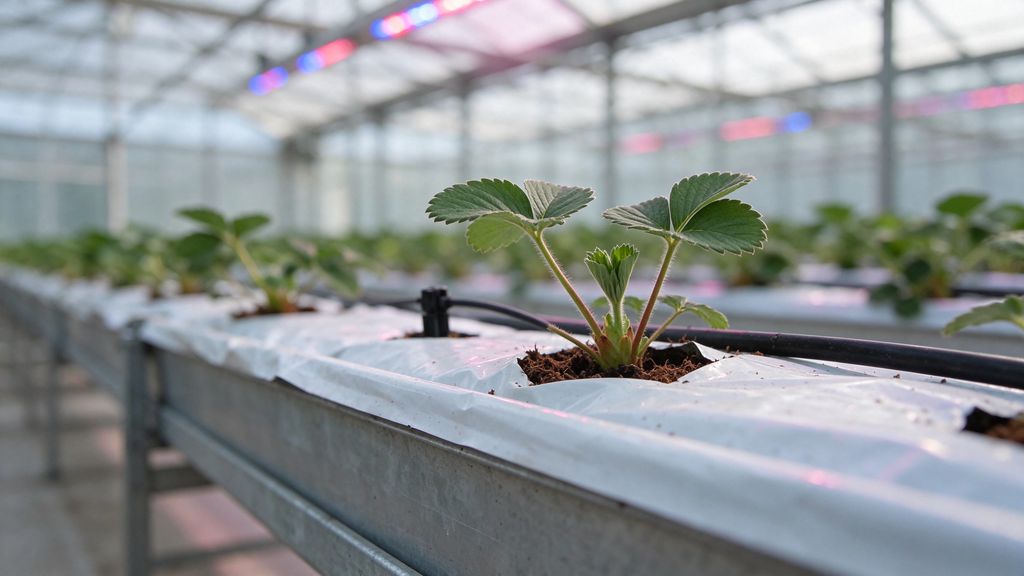
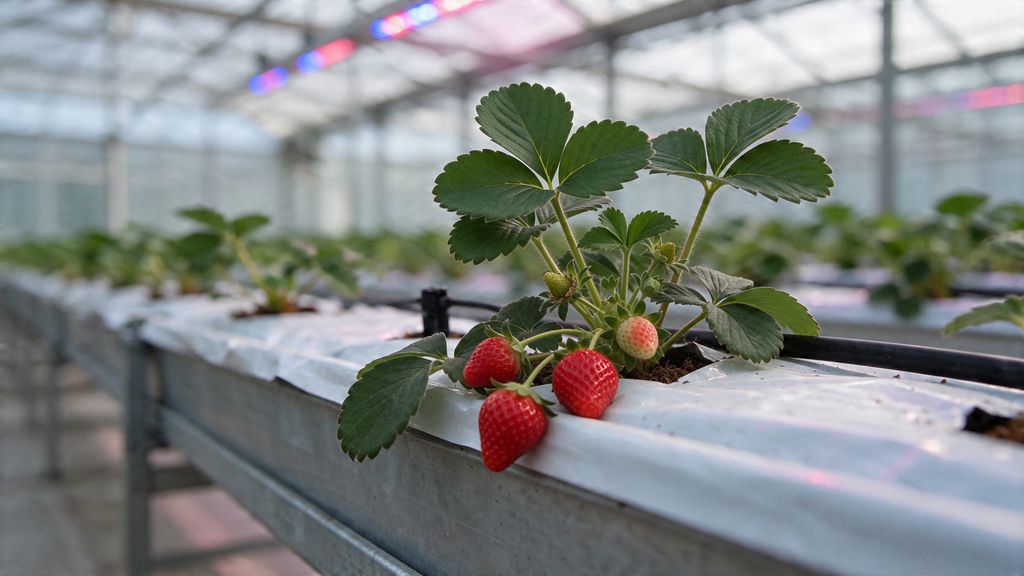
Stage 01/08
New leaf
After planting
The plant: A new trifoliate leaf unfolds from the crown while the roots spread through the substrate. Leaves appear at a pace set by accumulated warmth, and each one adds leaf area that will later feed flowers and fruit.
Light at this stage
- 12mol/m²/dayDLI, minimum
- 70–280µmol/m²/sSupplemental PPFD
What we control
A daily light target at crown height. Lamps add only what the daylight leaves short and dim back as the sun comes up, so the plant receives a steady daily light sum on grey and bright days alike.
What we measure
Lamp PPFD at crown height, daylight DLI from a fixed PAR sensor at canopy level, and the lamp share of each day.
Stage 02/08
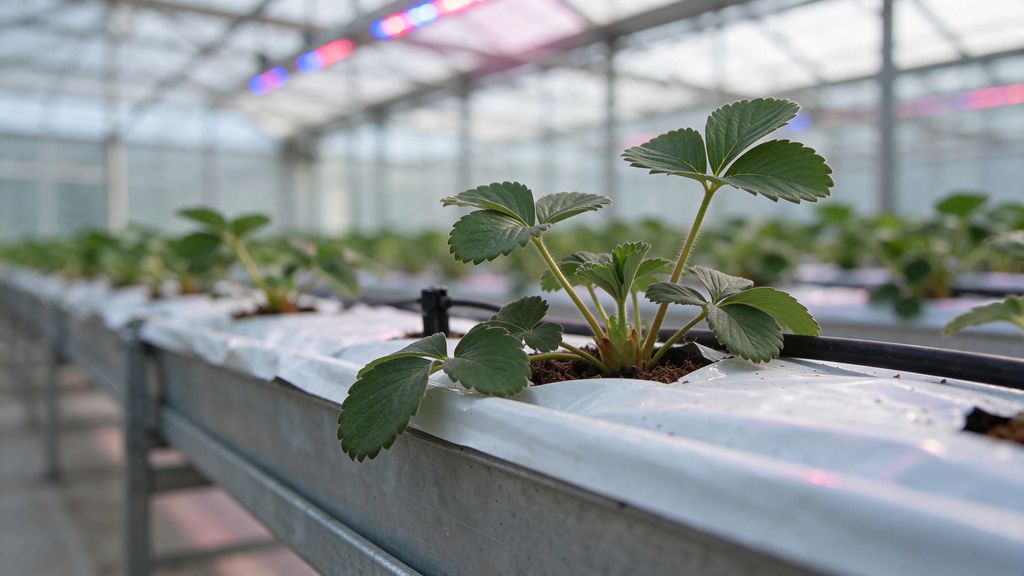
Crown and leaves
Before trusses appear
The plant: The crown thickens and, with the roots, stores the reserves that carry the first flowers and fruit; its buds turn into flowers, branch crowns or runners. Short-day cultivars initiate flowers when days fall below about 12–14 hours and stop above about 24 °C, while everbearers respond to long days, more strongly when warm.
Light at this stage
- < 12–14hDay length, short-day cultivars
- 16hDay length, everbearers
What we control
Day length is set by cultivar type. Short-day cultivars get a lit day under the critical length while the next trusses are initiated, with truly dark nights, stray light from nearby lamps included; everbearers get a long day. The far-red share of evening or night light counts toward the long-day signal and is set with the hours.
What we measure
Stray light at crown height at night, exact switching times, and canopy temperature through the initiation period.
Stage 03/08
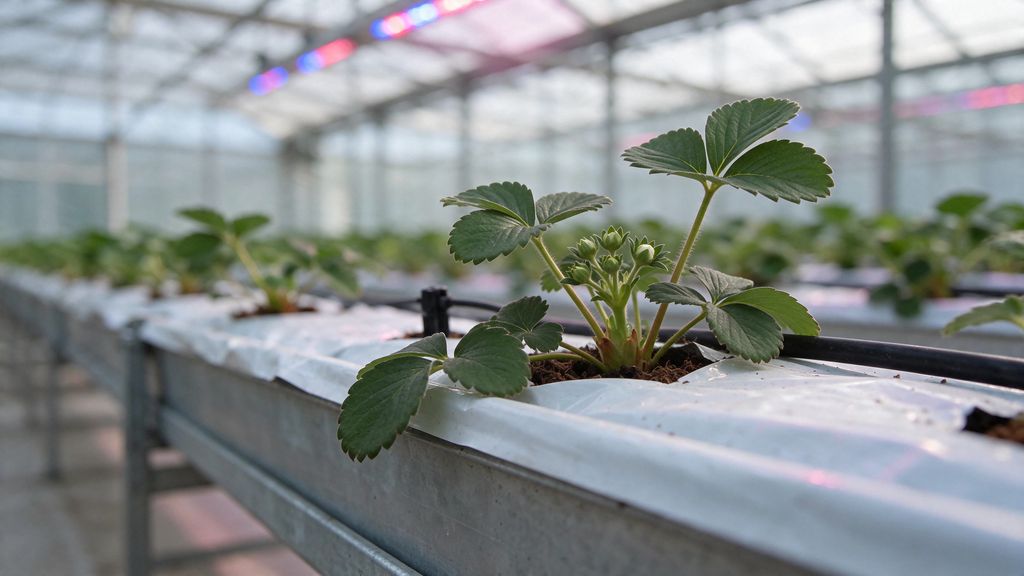
Flower truss
Before flowering
The plant: The truss emerging now was initiated earlier inside the crown, so the first crop depends on the flower buds the plant carried at planting. In the short days of winter, short-day cultivars slide into semidormancy: short petioles, a flat rosette and fewer new trusses.
Light at this stage
- 3–4hNight break
- ≥ 2µmol/m²/sSignal at the darkest plant
What we control
A low-power red and far-red signal at night, as a night break or a day extension, keeps short-day cultivars growing through winter, so petioles stay long and new trusses keep coming. Start and stop dates follow the crop, because the same signal at the wrong moment can hold back the next flower initiation.
What we measure
Red and far-red irradiance at night at the darkest plant, edge rows included, with far-red reported apart from PAR. Switch-on and switch-off times are logged every night.
Stage 04/08
Flowering
Day 0: flowers open
The plant: Each flower carries many pistils, and each fertilised pistil develops into an achene. Flowers are largely self-fertile, but bee visits fertilise more achenes and give larger, better-shaped fruit; flowers formed in hot weather are smaller and carry fewer carpels.
Light at this stage
- 16hLit photoperiod
- 70–280µmol/m²/sSupplemental PPFD
What we control
Supplemental light keeps the daily light sum up while flowers open and set. LEDs put far less radiant heat on the flowers than sodium lamps, so lamp schedules and climate set-points are planned together.
What we measure
Canopy temperature at flower height, logged with PPFD, so the effect of the lamps can be told apart from the effect of the climate.
Stage 05/08
Fruit set
Just after flowering
The plant: Fertilised achenes release auxin, and each one drives the growth of the flesh just beneath it. Where achenes stay unfertilised the flesh stays small, which is how poor pollination shows up as misshapen fruit.
Light at this stage
- 16hLit photoperiod
- 20mol/m²/dayDLI target
What we control
Even light at truss height along the whole gutter, so every truss receives a similar amount. Edge rows, gaps and gutter ends are part of the layout check.
What we measure
PPFD at truss height on a grid across the gutters, with the minimum-to-average ratio reported next to the average.
Stage 06/08
Green fruit
Up to about 3 weeks after flowering
The plant: The fruit now grows mostly by cell enlargement, which accounts for about 80% of its growth after flowering. Almost all of its sugar is imported from the leaves, so fruit size follows the light the leaves receive; warm weather speeds development and gives smaller fruit.
Light at this stage
- 16hLit photoperiod
- 20mol/m²/dayDLI target
- 12–25mol/m²/dayDLI range
What we control
The lamp share of each day is planned month by month from the site’s own daylight record. The daily light target holds through the darkest weeks, and the lamps stay off when the sun already delivers it.
What we measure
Daily light integral at canopy level, with daylight and lamp light logged separately against the target.
Stage 07/08
Colour break
About 3 weeks after flowering
The plant: Chlorophyll fades and the fruit turns white; from here to full ripeness, anthocyanins and sugars accumulate quickly. Colouring is most sensitive to light in the second half of fruit development.
Light at this stage
- 20–25mol/m²/dayDLI optimum
- > 30mol/m²/dayStress threshold
What we control
Trusses hang over the gutter edge, outside the leaf canopy, and the layout is set so light reaches the fruit as well as the leaves. In winter, far-red keeps petioles long and the plant open.
What we measure
Light at fruit height along the outer edge of the gutter, and fruit-zone temperature, which sets the pace of ripening.
Stage 08/08
Ripe fruit
About 30 days after flowering
The plant: Fruit reaches full red on average about 30 days after flowering, anywhere from 24 to 44 days depending on cultivar and the temperature after bloom. More light and longer days go with higher soluble solids and lower acidity, though the response differs between cultivars.
Light at this stage
- 16hLit photoperiod
- 20mol/m²/dayDLI target
What we control
The daily light sum is held through the last weeks before picking, while sugars are still arriving from the leaves. Lamp hours and energy are tracked against the daylight actually received, so the cost of each lit week is known.
What we measure
Days from tagged flowers to ripe fruit in the house itself, daily light over the ripening weeks, lamp hours and energy use.
How we do it
Six parts of every strawberry project
Their settings are worked out for the cultivar, the greenhouse and the site, and they change as the crop moves from stage to stage.
- 01
Light planned stage by stage
Establishment, flower initiation, flowering and fruit fill each get their own light: a day-length signal while trusses form, photosynthetic light while fruit fills. The schedule moves with the crop through the season.
- 02
Flowering steered by day length
Short-day and everbearing cultivars respond to day length in opposite directions. Night breaks, day extensions and the far-red share are set per cultivar and switched off when they would hold back the next truss.
- 03
Lamps dimmed against daylight
Lamps make up what the daylight leaves short of the target and step back as the sun rises. The plan starts from the site’s own daylight record, month by month.
- 04
Uniform light at crown and truss height
Layouts are checked at the height where crowns and trusses sit on the gutter, edge rows and gutter ends included. For the night signal, the darkest plant sets the design.
- 05
Measured before and after
Daylight, night-time stray light and canopy temperature are logged before installation. Afterwards the same points are measured again under the lamps, and lit benches are compared with unlit controls.
- 06
Tested in a digital twin first
Fixture height, spacing and hours are tried in a digital twin of the house, at its latitude and for each month, before anything is installed. Light maps and energy use come from the same calculation.
The system
Tabletop gutters under two kinds of light
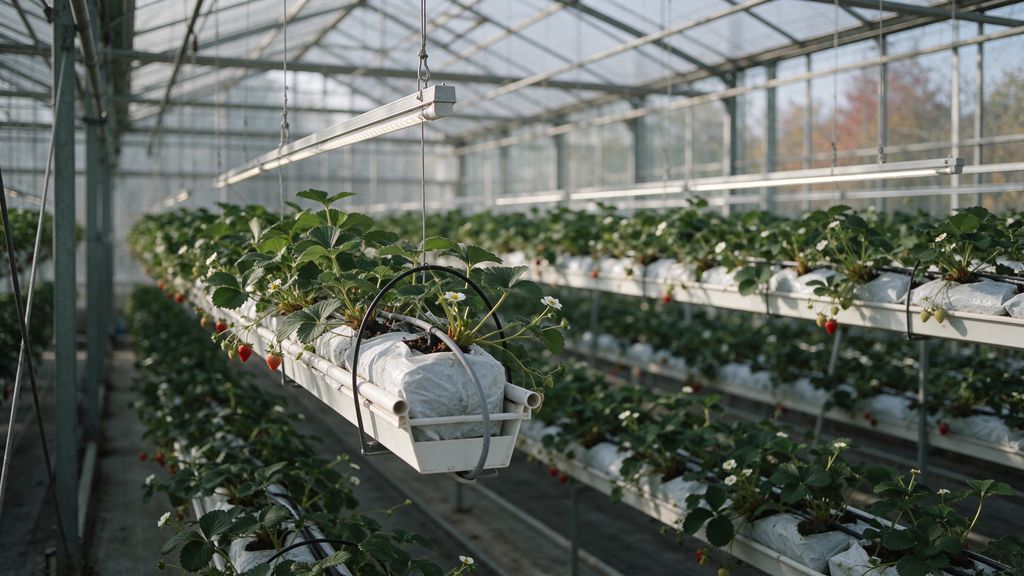
Raised gutters hold every crown at the same height, so light can be placed precisely: low-power bars for the night signal just above the rows, toplights for winter growth higher up.
What WONE delivers
Programme, luminaires and pilot
- 01
Programme and target
The light programme is matched to the cultivar and the goal, whether earlier flowering, more runners or winter fruit. Targets are agreed before any hardware is chosen.
- 02
Photoperiod luminaires
Low-power red and far-red bars for even night coverage along tabletop rows, in engineering development at WONE, with switching tied to the greenhouse schedule.
- 03
Pilot and scale-up
A few lit benches beside unlit controls, followed through a season. The decision to scale comes from the measured difference.
Explore the model
Switch between photoperiod lighting and winter toplighting. Change spacing, height and hours, and watch the light map and the numbers respond.
Explore the modelSimulation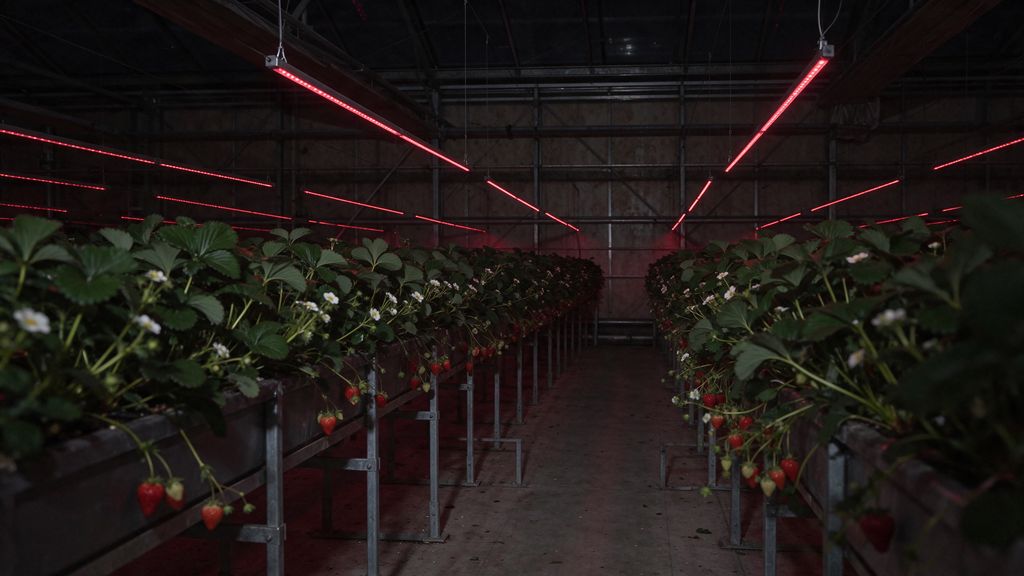
Step 1/5
The benches
Which plants need the light?
Tabletop gutters at working height, with aisles between them. The result is read on the plants alone.
Step 2/5
The luminaires
How many lines, and how high?
Linear luminaires run along the benches. The number of lines and the mounting height decide most of the cost.
Step 3/5
Light at the plants
Is the weakest plant above the threshold?
For photoperiod lighting the lowest red and far-red level matters more than the average. The map shows where the threshold is met.
Step 4/5
The schedule
How long, and at what cost?
Hours per night, or per day for photosynthetic lighting, turn into energy per month. Season and location belong to the same plan.
Step 5/5
Measurement
How do we know it works on the benches?
A few points at plant height are enough to compare the model with reality. Once linked, benches that drift below the target stand out.
Parameters
Decisions
What decides the design
Photoperiod design and the least-lit plant
Night-interruption lighting is judged by the lowest irradiance reaching any plant. Edge rows and plants under gaps decide whether the whole house responds.
Far-red is reported on its own
Far-red (700–800 nm) drives the photoperiod response and lies outside PAR. It is always shown as a separate number and never folded into PPFD.
Winter energy
Strawberries under toplights use a lot of electricity per kilogram in the darkest months. The model shows how many hours the lights would actually run, month by month, at the location you choose.
Tabletop precision
Raised gutters put the canopy at a predictable height, so luminaire height and spacing can be tuned closely and then checked plant by plant.
How the result is measured
Agree the cultivar, the programme and the success criteria (flowering date, runner count, yield per plant) before installation.
Light a few test benches beside untreated control benches, separated so that stray light stays below a stated limit.
Measure red and far-red irradiance at plant height at night across the benches, and log switching times.
Record crop responses weekly, and decide on scaling only from the measured difference.
Where light pays, and where it does not
Photoperiod lighting draws little power; its effect depends on how the cultivar responds, which a measured trial on a few benches shows. Winter toplighting suits heated, well-sealed greenhouses that grow for the winter market.
Related applications
Discuss your project
Crop, location, structure and what is already installed are enough to begin. We reply with the questions that shape the lighting design and an outline of what we would calculate and measure.