

- WONE Lighting
- Horticultural Lighting
- Applications
- Leafy greens & herbs
Application · Leafy greens & herbs
Lighting for leafy greens, herbs and microgreens
In a rack, all the light comes from the luminaires. Bar spacing, distance to the leaves and the number of hours set the crop, the energy bill and how evenly every tray grows.
Why light
Why light matters for greens and herbs
Sole-source light in racks sets the whole daily light integral. Too little gives soft, slow plants. Too much on lettuce raises the risk of tipburn: around 17 mol/m²/day is a practical ceiling with good downward air movement, and lower without it.
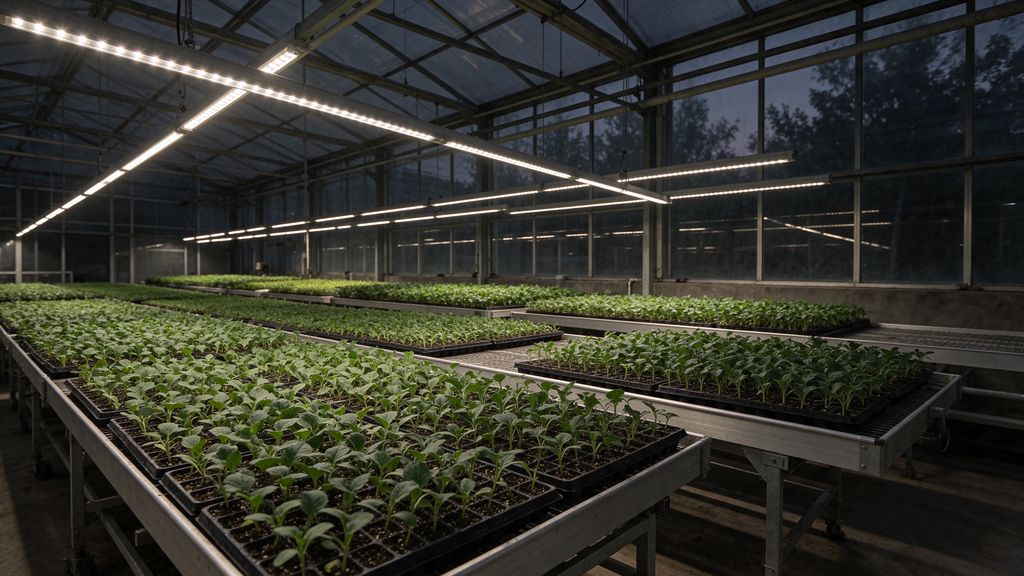
Greenhouse supplementation for lettuce and herbs supports year-round production where winter days are short. Whether it pays depends mostly on the price of electricity.
Spectrum shapes form and colour. Broad white with added red is the usual choice; far-red can enlarge leaves and speed growth, and it also stretches some crops.
Day length matters for spinach, which can bolt once days pass about 13 to 15 hours. Lit hours are set crop by crop.
 Research targetsLiterature
- Photoperiod
- 16 h16–24 h
- PPFD under sole-source light
- 160–300µmol/m²/s
- Daily light integral
- 12–17mol/m²/day
- Photoperiod
- 16 h14–18 h
- PPFD under sole-source light
- 160–310µmol/m²/s
- Daily light integral
- 9.3–17.8mol/m²/day
- Photoperiod
- 12 h10–13 h
- PPFD under sole-source light
- 250–400µmol/m²/s
- Daily light integral
- 14–17.3mol/m²/day
- Photoperiod
- 16 h12–18 h
- PPFD under sole-source light
- 100–600µmol/m²/s
- Daily light integral
- 6–18mol/m²/day
Ranges reported in the literature. Cultivar, climate, crop stage and market move them; every project begins by agreeing the target for that crop and that house.
The system
Multilayer racks, tier by tier
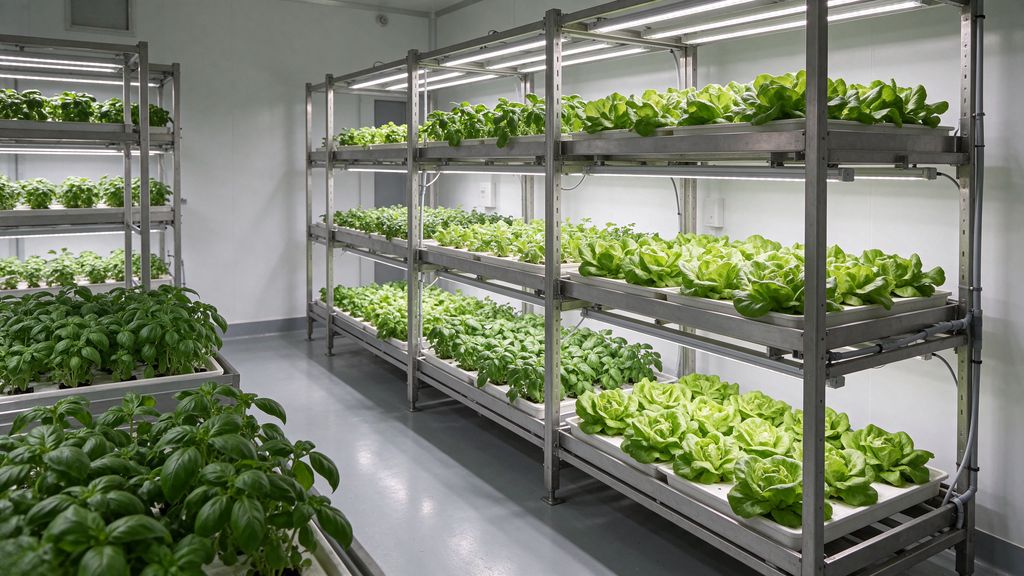
Every tier is a small growing room of its own: bars a short distance above the trays, light returned from the sides, and heat that the room’s air handling has to carry away.
What WONE delivers
Layout, schedule and measurement per tier
- 01
Tier design
Bar spacing and distance to the canopy chosen for even light from the centre of each tray to its edge.
- 02
Crop programmes
Daily light, hours and spectrum set per crop, from microgreens to head lettuce, at the lowest level that still delivers the required quality.
- 03
Energy and verification
Light measured on several tiers and power logged per tier, then compared with the design.
Explore the model
A room with two racks of four tiers. Choose the crop, change bar spacing, distance to the canopy and hours, and follow PPFD, uniformity, DLI and energy for one tier.
Explore the modelSimulation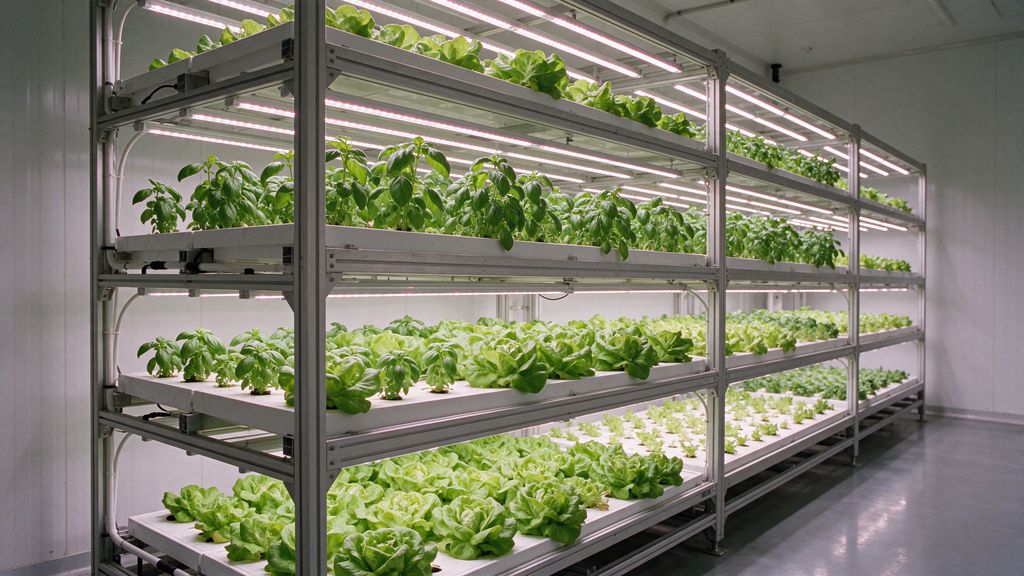
Step 1/5
The racks
How much growing area is there?
Multi-tier racks in a closed room, trays at a fixed height on every tier, each tier lit by its own bars.
Step 2/5
The light bars
How close, and how many bars?
Bar spacing and distance to the leaves decide both the evenness of the light and the power per square metre of tier.
Step 3/5
Light at the leaves
Is the edge of the tray as bright as the centre?
The map covers the whole tray. Average and uniformity show whether the outer rows will lag behind.
Step 4/5
The photoperiod
Does the daily dose match the crop?
Without sun, every mole of light comes from the bars. Hours per day set the daily light integral, checked against the crop target.
Step 5/5
Measurement
What do sensors add?
Readings per tier reveal ageing, dust and dimming that no drawing shows. The model becomes the reference the room is held to.
Parameters
Decisions
What decides the design
Distance, spacing and uniformity
Bars close to the canopy waste less light but leave stripes; further away the map evens out and the average falls. The model makes the trade visible.
Reflective sides
White or reflective side panels return light that would otherwise leave the tier, and they lift the edge trays most.
Heat in the room
All electrical power ends up as heat, so lighting and HVAC are designed together. The energy figure in the model is lighting only.
Lower light for microgreens
Microgreens are harvested within days and need far less daily light than lettuce. Over-lighting them is one of the easiest ways to waste energy.
How the result is measured
Measure PPFD at tray height on several tiers, with the neighbouring tiers lit.
Check the effect of tray position (edge and centre) and of reflective panels.
Log hours and power per tier, and compare kWh per tray with the design.
Where light pays, and where it does not
Vertical farming of leafy greens and herbs is emerging in Türkiye, mostly in small facilities. Margins are thin and electricity is the largest variable cost, so the design target is the lowest daily light integral that produces the required quality, delivered evenly.
Related applications
Discuss your project
Crop, location, structure and what is already installed are enough to begin. We reply with the questions that shape the lighting design and an outline of what we would calculate and measure.