

- WONE Lighting
- Horticultural Lighting
- Applications
- Dragon fruit
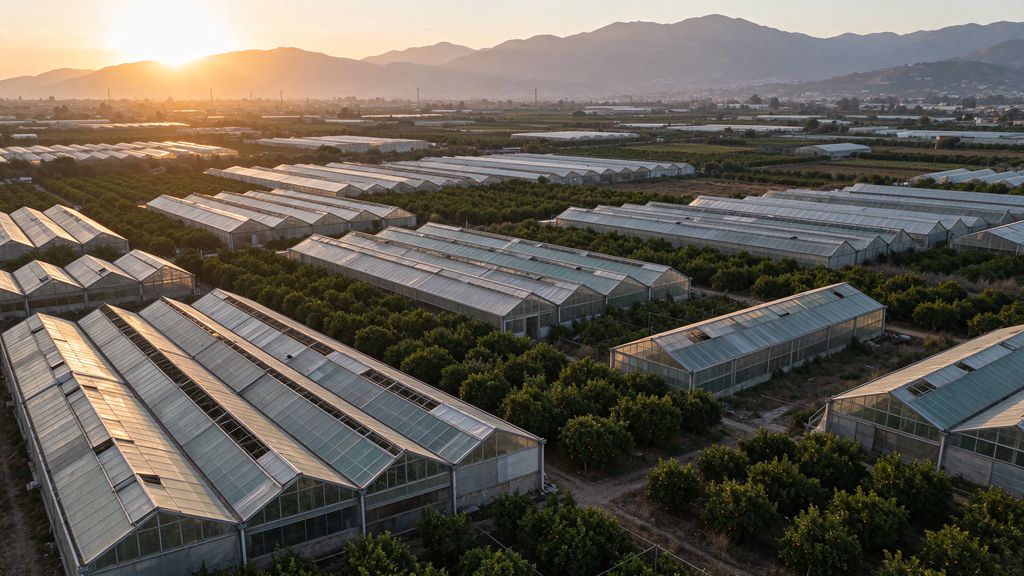
Application · Dragon fruit (Türkiye)
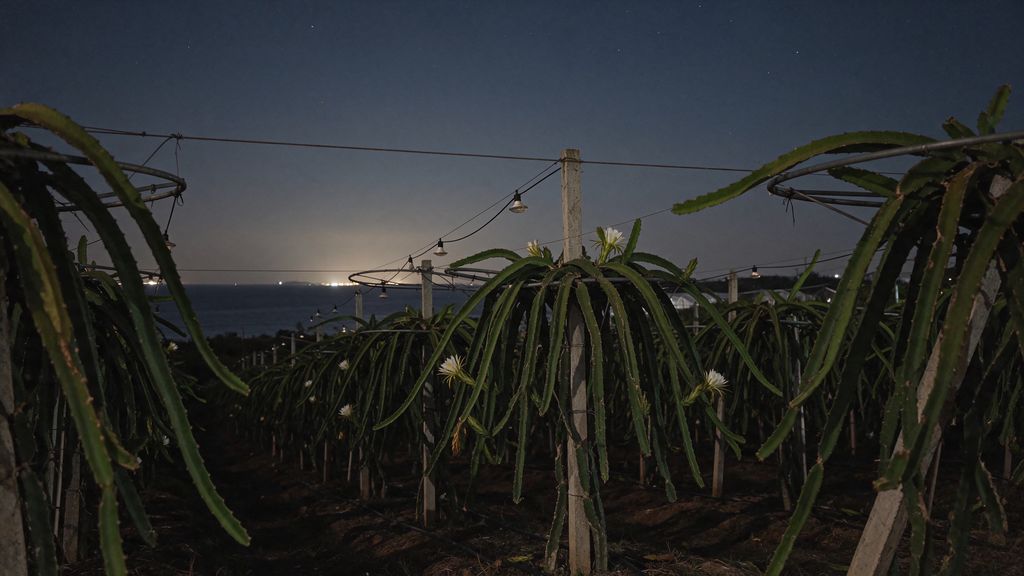
Night-break lighting for dragon fruit
Pitaya flowers when nights are short. A few hours of light in the middle of long autumn and winter nights can bring flowers outside the natural season. The light is a low-intensity signal and adds almost nothing to photosynthesis.
Why light
Why light matters for pitaya
Night-break lighting interrupts the long night so the plant reads a short one. Studies in Taiwan, Vietnam and China report off-season flowering under night-break lighting with incandescent lamps or LEDs.
The intensity is low. The aim is a signal of a few µmol/m²/s (tens of lux in older studies) delivered evenly to every stem. The design target is the lowest value on any stem; daily light integral plays no part.
Timing. Start date, length of the night break and number of nights decide the response, together with temperature, which also limits flowering in cool winters.
 Research targetsLiterature
- Working threshold at plant level
- ≥ 1.6 µmol/m²/s1.6–4.4 µmol/m²/s · PAR, at the darkest plant
- Night break
- 4 h per night
Ranges reported in the literature. Cultivar, climate, crop stage and market move them; every project begins by agreeing the target for that crop and that house.
The system
Post-trained rows, lit in the middle of the night
Cactus stems climb posts in long rows, under film or in the open. Small lamps along each row have to reach every stem with the same faint signal, through rain, dust and summer sun.
What WONE delivers
A measured route to off-season flowering
- 01
Night-break programme
Start date, hours per night and number of nights matched to the cultivar and to local night temperatures.
- 02
Outdoor-ready hardware
Low-power photoperiod lamps for rows in the open and under film. WONE’s linear photoperiod luminaire is in engineering development.
- 03
Pilot with control rows
Lit and unlit rows side by side, with buds, flowering dates and night temperature recorded through the season.
Explore the model
Rows of post-trained pitaya with lamps along each row. Change lamp spacing and height and check whether every plant receives the working threshold during the night break.
Explore the modelSimulation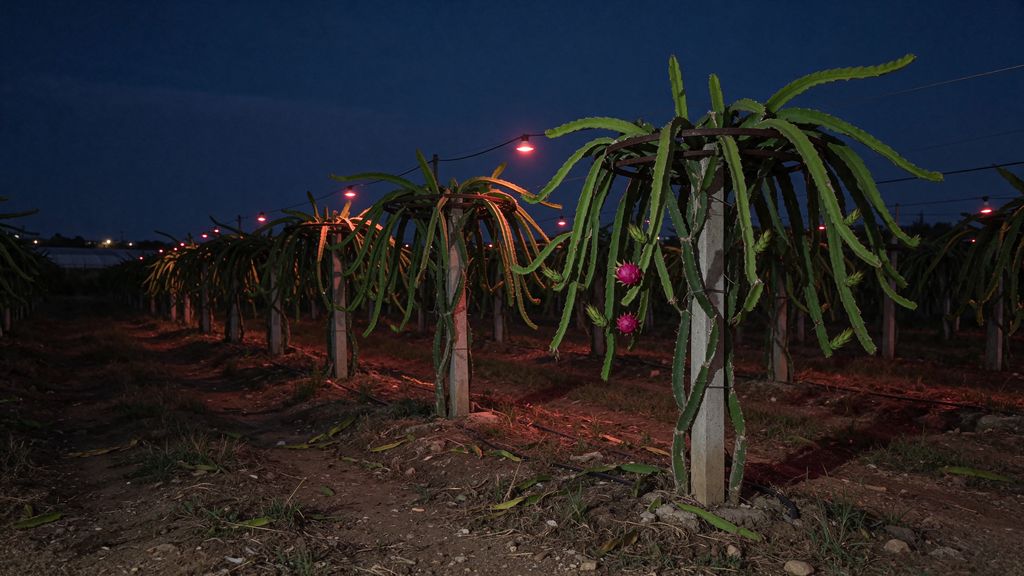
Step 1/5
The rows
What is being lit?
Post-trained pitaya in rows, with cladodes at the height where flowering starts. The result covers the canopy along the posts.
Step 2/5
The lamps
How many lamps per row?
Lamps hang along the rows at a set height and spacing. The installed load is known before a cable is pulled.
Step 3/5
Light on the cladodes
Does the weakest cladode reach the threshold?
Night-break lighting is judged by the lowest red and far-red level on the crop. The map shows where it is reached.
Step 4/5
The night break
How many hours, and in which months?
A few hours in the middle of the night during the short-day season. Energy per night follows from the hours and the lamps.
Step 5/5
Measurement
How can the effect be confirmed?
Points along the rows compare the calculated level with the field. Combined with flowering records, the next season is planned on evidence.
Parameters
Decisions
What decides the design
Even light along the rows
Plants between lamps receive the least light. The lowest value on the crop decides the design.
Lux in older studies
Many pitaya studies report illuminance in lux. Designs are shown in both lux and photon units so they can be read against that work.
Outdoor hardware
Field and tunnel installations face rain, dust and sun. Protection, cabling and electrical safety are designed in from the start.
Night temperature
Studies report that induced flowering needs warm nights, around 15 °C or more; one study saw no flowering at 27/17 °C day/night, and trials in Israel found no lighting effect at all. On Türkiye’s coast, mid-winter induction may therefore need heating, and a pilot records night temperature next to the light.
How the result is measured
Measure irradiance, with illuminance for comparison, at stem height under and between lamps.
Keep lit and unlit rows, separated so that stray light on the control rows stays below a stated limit.
Record flower buds, flowering dates and fruit set per row, with night temperatures.
Where light pays, and where it does not
Off-season fruit can command higher prices, and the electrical load is small. Whether the response is reliable in Türkiye’s climate is still open: one commercial greenhouse in Aydın is reported to use LED night lighting, and no Turkish trial has been published. A measured pilot is the next step.
Related applications
Discuss your project
Crop, location, structure and what is already installed are enough to begin. We reply with the questions that shape the lighting design and an outline of what we would calculate and measure.