

- WONE Lighting
- Horticultural Lighting
- Applications
- Greenhouse vegetables
Application · Greenhouse vegetables
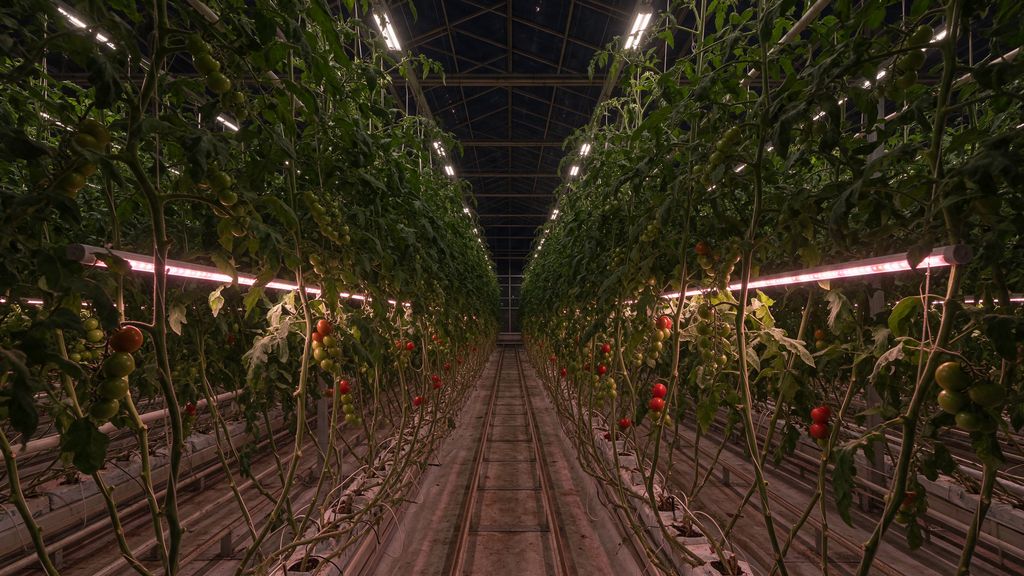
Lighting for greenhouse tomato, pepper and cucumber
Every design for high-wire tomato, pepper and cucumber answers four questions: how much light, for how many hours, from above or inside the canopy, and at what cost per square metre.
Why light
Why light matters in tall canopies
Toplighting raises the daily light integral when the sun is weak. It is sized in PPFD at the top of the canopy and run for as many hours as the crop tolerates and the economics allow.
Interlighting brings light inside the canopy, to the lower leaves that are otherwise shaded. It is installed per metre of row and judged by the light that reaches those leaves.
Schedules matter as much as fixtures. Lights that run only when daylight falls short of the daily target use less energy than a fixed schedule.
 Research targetsLiterature
Tomatoes respond strongly to added winter light but do not tolerate continuous light: photoperiods beyond about 18 hours can injure the leaves, so the daily schedule is capped. Cherry, cocktail and on-the-vine types follow the same physiology with different economics.
- Photoperiod
- 16 h12–18 h
- Supplemental PPFD
- 100–300µmol/m²/s
- Daily light integral
- 20–30mol/m²/day
Lit winter crops of sweet pepper are recent and less common than lit tomato and cucumber. The canopy is dense, so how light spreads inside it matters, which is why interlighting is discussed for this crop.
- Photoperiod
- 18 h14–20 h
- Supplemental PPFD
- 80–220µmol/m²/s
- Daily light integral
- 20–30mol/m²/day
Cucumbers grow fast and are often lit through the winter, with toplights and at some sites interlighting. They tolerate longer photoperiods than tomato.
- Photoperiod
- 18 h16–20 h
- Supplemental PPFD
- 100–250µmol/m²/s
- Daily light integral
- 20–30mol/m²/day
Ranges reported in the literature. Cultivar, climate, crop stage and market move them; every project begins by agreeing the target for that crop and that house.
The system
A greenhouse lit from above and from within
Toplights raise the light on the upper leaves; interlights between the plants reach the shaded middle of the canopy. Both are planned together, row by row, around the daylight the house already receives.
What WONE delivers
Design, controls and proof for lit greenhouses
- 01
Lighting design
Luminaire choice, layout and mounting height for the crop and the house, with the light at the canopy calculated before anything is ordered.
- 02
Schedules and controls
Lights that run only when daylight falls short of the daily target, with zoning and dimming set per crop and per season.
- 03
Retrofit and verification
A start from the lamps, power and controls already in place, and a measured light map after every change.
Explore the model
Choose tomato, sweet pepper or cucumber, change luminaires per row, mounting height and output, and compare a fixed schedule with lighting only to the daily target. Daylight follows the location you pick.
Explore the modelSimulation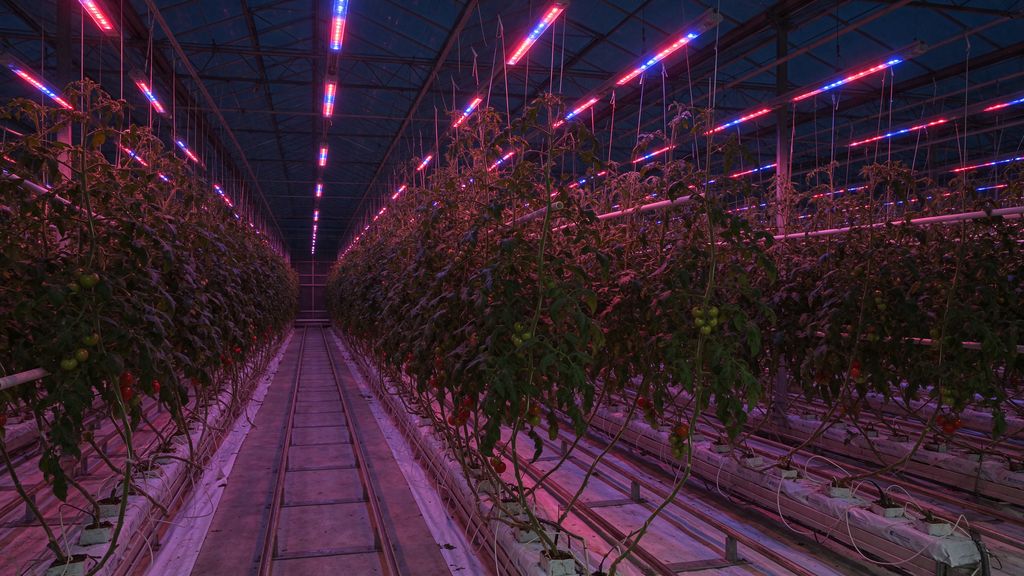
Step 1/5
The compartment
What exactly are we lighting?
A section of a high multi-span plastic greenhouse with high-wire rows, paths and the canopy at its working height. Every later figure refers to this crop in this space.
Step 2/5
The luminaires
How much light hangs above the rows?
Toplights at a set height and spacing above the wires. The installed load per square metre is known before anything is ordered.
Step 3/5
Light at the canopy
Does every plant get the same light?
The light map is read at the top of the canopy, only where plants stand. Average and uniformity show whether the layout serves the whole row or only its middle.
Step 4/5
The season
How many hours does January need?
Natural light changes month by month. The lamps add only what the sun does not deliver, so hours and kilowatt-hours follow the season.
Step 5/5
Measurement
What changes once sensors are added?
Measurement points sit at canopy height across the section. Linked to sensors, the calculated values become the reference the greenhouse is compared with.
Parameters
Decisions
What decides the design
Uniformity at the top of the canopy
An average PPFD can hide dark rows. Designs are judged on the weakest rows as well as the mean.
Photoperiod limits
Each crop has a practical ceiling on lit hours. The model caps the schedule per crop and shows when even the maximum cannot reach the target.
Heat and humidity
LED toplights put less radiant heat on the crop than older lamps, which shifts heating demand and climate control. The effect is flagged for the climate engineer.
Existing installations
Many sites already have lamps, power and controls. Zoning, schedules and partial replacement are examined before full replacement.
How the result is measured
Map PPFD at canopy height at fixed points, at night with lights on.
Log schedules, dimming levels and daylight from the climate computer for at least a month.
Compare measured averages and uniformity with the design, and explain any difference.
Repeat after every change, at the same points.
Where light pays, and where it does not
Where winter daylight is short, lit tomato and cucumber production is established, and toplighting retrofits are best served by certified luminaires and good controls. In most of Türkiye, high-power toplighting for these crops does not pay at current produce prices; heated and geothermal greenhouses are the exception worth calculating.
Related applications
Discuss your project
Crop, location, structure and what is already installed are enough to begin. We reply with the questions that shape the lighting design and an outline of what we would calculate and measure.