
- Home
- Technology
Technology & measurement
Units first. Claims second.
Horticultural lighting is easy to describe loosely and hard to describe correctly. These are the quantities we use, how we measure them and how we label what we know.
Quantities
What we measure and report.
| Quantity | Unit | Definition | Waveband |
|---|---|---|---|
| Photosynthetic photon flux (PPF) | µmol/s | Photons emitted by a luminaire per second | 400–700 nm |
| Photosynthetic photon flux density (PPFD) | µmol/m²/s | Photons arriving per square metre per second | 400–700 nm |
| Daily light integral (DLI) | mol/m²/day | PPFD summed over a day: PPFD × hours × 0.0036 | 400–700 nm |
| Far-red photon flux (density) | µmol/s (µmol/m²/s) | Reported separately from PAR (ANSI/ASABE S640 band) | 700–800 nm |
| Extended PAR (ePAR) | µmol/s | Research convention (Zhen and colleagues, 2021), not part of S640; used only when stated | 400–750 nm |
| Photon efficacy | µmol/J | PPF divided by electrical input power | 400–700 nm unless stated |
| UV-A, UV-B | µmol/s or W | Reported separately, never added to PAR | 315–400 nm, 280–315 nm |
| Electrical power, energy | W, kWh | Input power; energy = power × hours | — |
Illuminance (lux) is weighted for the human eye and is not a measure of light for plants. We show it only to compare with older studies that used it.
Measurement
How we measure in a greenhouse or growth room.
Instruments
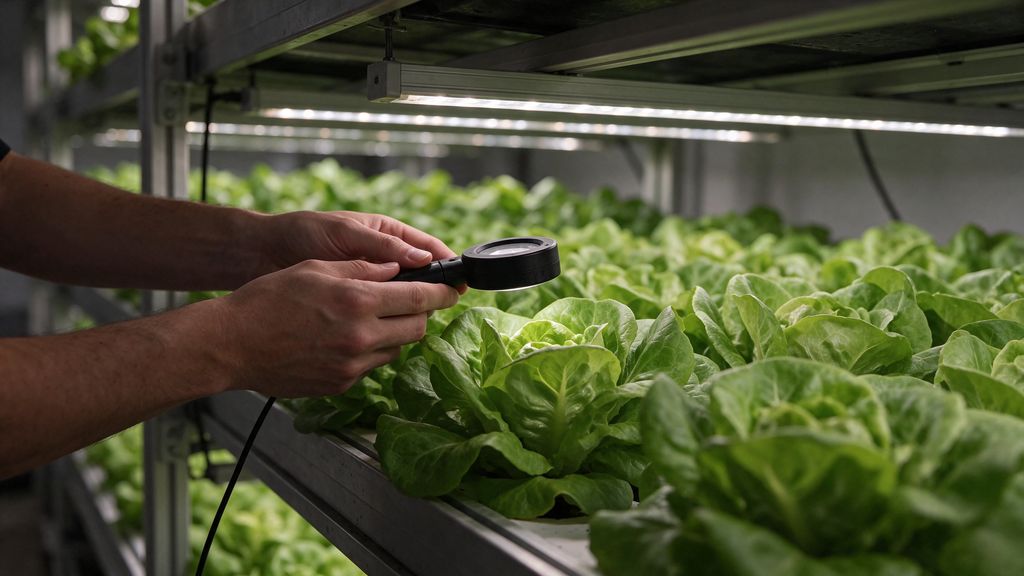
Calibrated quantum sensors for PPFD and a spectroradiometer for spectra, with calibration dates on every report. A quantum sensor is not a spectroradiometer; we say which was used.
Grid and height
Measurements on a fixed grid at canopy height, over crop areas only, with the grid and positions documented so they can be repeated.
Separating sun and lamp
Lamp contribution is measured at night or with the sun excluded; natural light is logged separately.
Standards
Quantities and units follow ANSI/ASABE S640. Luminaire measurement references ANSI/ASABE S642 and S642.1 (2025), IES LM-79-24 and the IES TM-33-23 data format. North American utility incentives refer to the DesignLights Consortium horticultural requirements V4.0 (2025), which set a photon efficacy floor of 2.5 µmol/J on PAR (400–700 nm).
Evidence and sources
- ANSI/ASABE S640 JUL2017 (R2022). Quantities and Units of Electromagnetic Radiation for Plants (Photosynthetic Organisms). ASABE. webstore.ansi.org
- ANSI/ASABE S642 SEP2018. Recommended Methods for Measurement and Testing of LED Products for Plant Growth and Development. ASABE. webstore.ansi.org
- ANSI/ASABE S642.1 SEP2025. Measurement and testing of electromagnetic radiation sources (LED and non-LED) for plant growth, 280-800 nm. ASABE. webstore.ansi.org
- ANSI/IES LM-79-24. Optical and Electrical Measurements of Solid-State Lighting Products. IES, 2024; LightNOW 2024-06 'IES approves updated LM-79'. lightnowblog.com
- ANSI/IES TM-33-23. Standard Format for the Electronic Transfer of Luminaire Optical Data. IES, 2023. shop.standards.ie
- DesignLights Consortium. Horticultural Lighting Technical Requirements V4.0 (effective 18 April 2025). designlights.org
- LightNOW (2025-02-25). DLC finalizing Horticultural V4.0 Technical Requirements (efficacy threshold 2.5 µmol/J, +8.7% vs V3.0). lightnowblog.com
- UL Solutions (2023-02-15). Changes to DLC Horticultural Requirements V3.0 (PPE 2.3 µmol/J). ul.com
- DesignLights Consortium (2021). Horticultural Lighting Resources: Terms and Definitions. designlights.org
- DesignLights Consortium (2021). Limitations of Predicting Far-Red's Effect on Photosynthesis (white paper). designlights.org
- Ashdown, I. (2023-06-08). Comparing PAR and ePAR metrics for horticultural luminaires. Buildings. buildings.com
Uniformity
Average PPFD is half the story.
We report minimum/average (U1), average/maximum and the coefficient of variation, calculated over the crop area only. Paths, walls and edges are shown on maps but excluded from crop statistics, because including them makes a good design look bad and a bad design look acceptable.
Evidence labels
Four kinds of information, never mixed.
Recorded with a stated instrument, method and date at a real installation or in a laboratory.
Calculated by our model from stated inputs. Shown with its assumptions.
Reported in published research or extension sources, cited with the source.
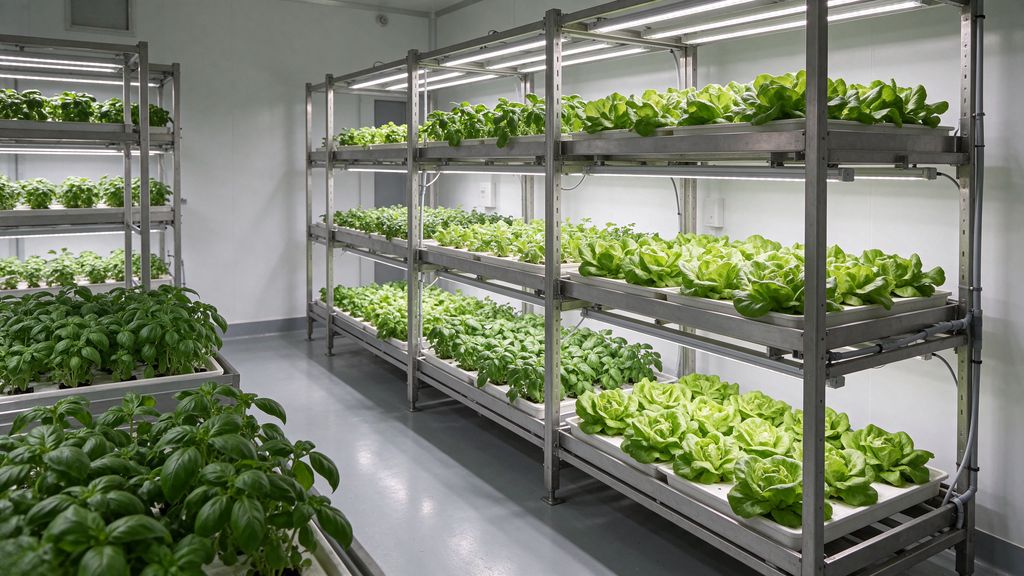
Illustrations and products not yet built or measured.
Data and software
What software does today, and what is planned.
Available now
Light-distribution calculation, DLI and energy schedules, and interactive models like the ones on this site.
Planned with pilot sites
Logging of measured PPFD and schedules against the model; anomaly detection on logged sensor data, such as a zone delivering less light than designed; scheduling assistance that suggests lit hours from forecast natural light. These are not available yet.
A camera can document plant growth and uniformity. It does not measure sugar, vitamin or mineral content, and we do not suggest otherwise.
Tell us about the crop and the space.
The crop, the location, the structure and what is already installed are enough to start. We reply with the questions that decide the lighting design and an outline of the measurements we would take.