- Home
- Home Growing
Home growing
A small shelf, the same physics.
Herbs, lettuce, microgreens and seedlings can grow well indoors under a modest LED shelf. Here is what works, what it uses in electricity and where hobby growing ends.
What grows well
Start with crops that forgive.
Culinary herbs
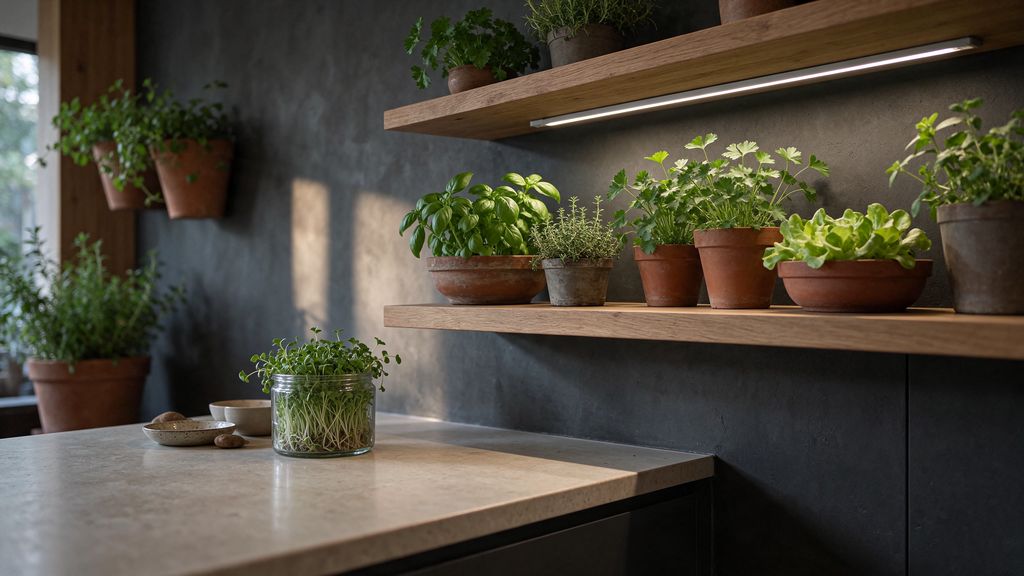
Basil, parsley, mint, chives and thyme do well under a bar 20–30 cm above the leaves. Basil wants the most light.
Lettuce and compact greens
Loose-leaf lettuce and baby greens can be cut repeatedly. Keep the room cool; warm rooms make lettuce bitter and leggy.
Microgreens
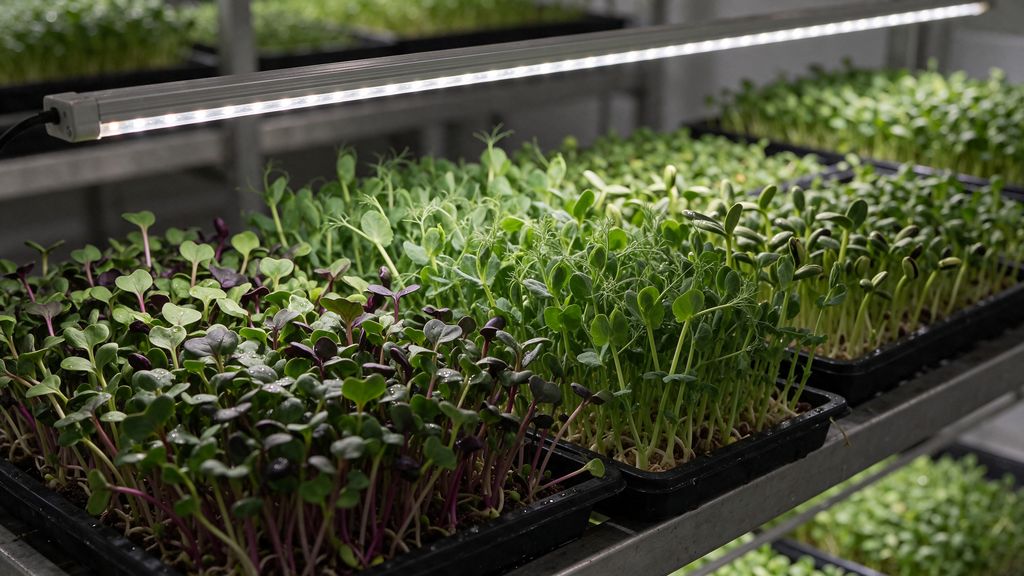
The easiest start: a tray, a week or two, and much less light than mature plants need.
Seed starting
Tomato, pepper and flower seedlings for the balcony or garden stay compact under a light close above them, instead of stretching toward a window.
Small strawberry experiments
Day-neutral strawberry varieties can flower and fruit indoors, but they need more light, space and patience. Treat it as an experiment, not a harvest plan.
Try the model
A shelf with one to three LED bars. Choose the crop, the number of bars and the distance, and see the light on the leaves, the daily light integral and the electricity used.
- Ohio State Univ., OHCEAC. Controlled Environment Berry Production Information — Photosynthetic Lighting. ohceac.osu.edu
- Park, Y., Sethi, R., Temnyk, S. (2023). Growth, flowering, and fruit production of strawberry 'Albion' in response to photoperiod and photosynthetic photon flux density of sole-source lighting. Plants 12(4):731. doi:10.3390/plants12040731 mdpi.com
- Lanoue, J., Zheng, J., Little, C., Thibodeau, A., Grodzinski, B., Hao, X. (2019). Alternating red and blue light-emitting diodes allows for injury-free tomato production with continuous lighting. Front. Plant Sci. 10:1114. doi:10.3389/fpls.2019.01114 frontiersin.org
- Mattson, N. (2016, October). Growing hydroponic leafy greens. GPN (Cornell CEA). cea.cals.cornell.edu
- Dou, H. et al. (2018). Responses of sweet basil to different daily light integrals in photosynthesis, morphology, yield, and nutritional quality. HortScience 53(4). vufind-test.katalog.k.utb.cz
- Gerovac, J.R., Craver, J.K., Boldt, J.K., Lopez, R.G. (2016). Light intensity and quality from sole-source light-emitting diodes impact growth, morphology, and nutrient content of Brassica microgreens. HortScience 51(5):497-503. ars.usda.gov
- Wuetcher, L.T., Owen, W.G. (2025-03-11). Managing daily light integral to improve vegetable transplant quality. Purdue Vegetable Crops Hotline 749 (e-GRO). vegcropshotline.org
WONE does not sell home-growing products at present. The model uses a generic LED bar for illustration.
Practical matters
Before you buy anything.
Space
A 80 × 35 cm shelf with 30–40 cm of height is enough for herbs or lettuce; seedlings and microgreens need less height.
Light schedule
A plug-in timer is the most useful accessory: 12–16 hours depending on the crop, the same hours every day.
Energy
Two 18 W bars for 16 hours use about 0.58 kWh a day, roughly 17 kWh a month. Check the figure against your own tariff.
Noise and heat
Passively cooled LED bars are silent and warm slightly. Bars with fans can be heard in a quiet room.
Cleaning and water
Keep water away from the electrics, wipe the lens when dusty, and use trays under pots. Mains-powered products must be installed as their instructions say.
Eyes
Do not look directly into LED bars. Ordinary home growing does not need UV light, and we do not recommend UV-B products for home use.
Hobby or production?
A home shelf produces fresh herbs and greens, and a lot of learning. It will not make a household self-sufficient, and harvests vary with variety, temperature and care. Commercial production is a different discipline, with its own economics; that is what the rest of this site is about.