
- Home
- Applications
- Leafy greens & herbs
Application · Leafy greens & herbs
Leafy greens and herbs, tier by tier.
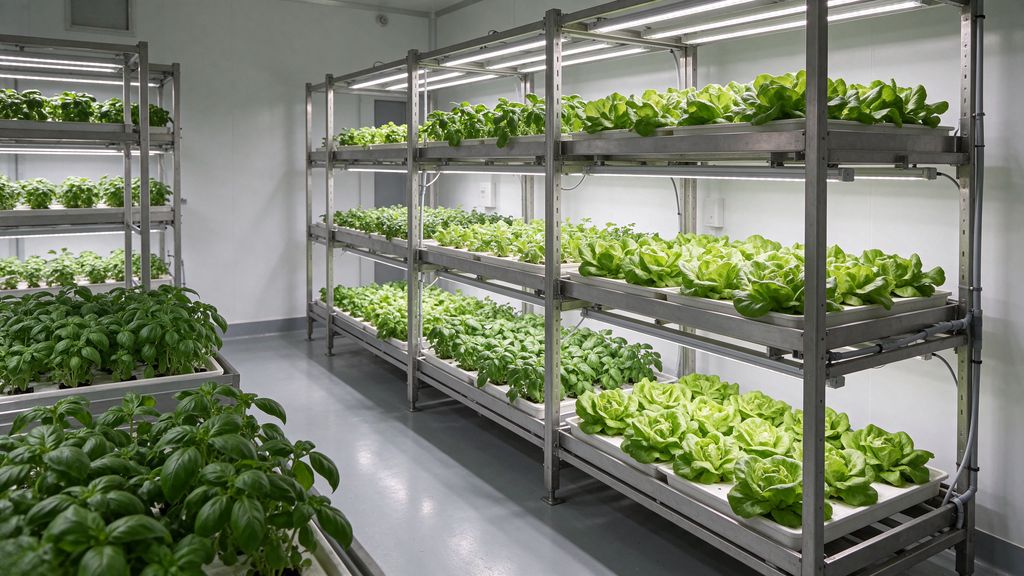
In a rack, the luminaire is the only light. Spacing, distance to the canopy and the number of hours define the crop, the energy bill and the uniformity from tray to tray.
What light does for these crops
Sole-source light in racks sets the whole daily light integral. Too little gives soft, slow plants. Too much on lettuce raises the risk of tipburn: around 17 mol/m²/day is a practical ceiling with good downward air movement, and lower without it.
Greenhouse supplementation for lettuce and herbs is common in Québec, where a dedicated electricity rate for photosynthetic lighting supports year-round production.
Spectrum shapes plant form and colour. Broad white with added red is the usual choice; far-red can enlarge leaves and speed growth but also stretches some crops.
Day length matters for spinach, which can bolt once days exceed about 13 to 15 hours. Hours are set per crop, not by habit.
- Photoperiod
- 16 h16–20 h
- PPFD under sole-source light
- 200–300µmol/m²/s
- Daily light integral
- 12–17mol/m²/day
- Photoperiod
- 16 h14–18 h
- PPFD under sole-source light
- 150–300µmol/m²/s
- Daily light integral
- 9.3–17.8mol/m²/day
- Photoperiod
- 12 h10–13 h
- PPFD under sole-source light
- 250–400µmol/m²/s
- Daily light integral
- 14–17.3mol/m²/day
- Photoperiod
- 16 h12–18 h
- PPFD under sole-source light
- 100–300µmol/m²/s
- Daily light integral
- 6–18mol/m²/day
Values are ranges reported in the sources listed. Cultivar, climate, stage and production goal move them; a project starts by agreeing the target for that crop.
Try the model
A two-rack room with four tiers each. Change bar spacing, distance to the canopy and hours, choose the crop, and see PPFD, uniformity, DLI and energy for one tier.
- Balázs, L., Dombi, Z., Csambalik, L., Sipos, L. (2022). Characterizing the spatial uniformity of light intensity and spectrum for indoor crop production. Horticulturae 8(7):644. doi:10.3390/horticulturae8070644 mdpi.com
- Runkle, E. Investment considerations for greenhouse lighting. Michigan State Univ. Floriculture / GPN 'Under Control'. canr.msu.edu
- Mattson, N. (2016, October). Growing hydroponic leafy greens. GPN (Cornell CEA). cea.cals.cornell.edu
- Both, A.J. (2003). Ten years of hydroponic lettuce research (Cornell CEA). haifa-group.com
- Kelly, N., Choe, D., Meng, Q., Runkle, E. — Produce Grower summary: Photoperiod, light intensity and daily light integral (lettuce 'Rex', 'Rouxai'). producegrower.com
- Sheibani, F., Bourget, M., Morrow, R.C., Mitchell, C.A. (2023). Close-canopy lighting, an effective energy-saving strategy for overhead sole-source LED lighting in indoor farming. Front. Plant Sci. 14:1215919. doi:10.3389/fpls.2023.1215919 frontiersin.org
- Ertle, J., Kubota, C. (2025). Nighttime blue lighting and downward airflow to manage tipburn in indoor farm lettuce. HortScience 60(3):325. journals.ashs.org
- Chun, C. et al. (2000). Bolting and growth of Spinacia oleracea L. can be altered by modifying the photoperiod during transplant production. HortScience 35(4):624-626. journals.ashs.org
- Gao, W., He, D., Ji, F., Zhang, S., Zheng, J. (2020). Effects of daily light integral and LED spectrum on growth and nutritional quality of hydroponic spinach. Agronomy 10(8):1082. doi:10.3390/agronomy10081082 mdpi.com
- Dou, H. et al. (2018). Responses of sweet basil to different daily light integrals in photosynthesis, morphology, yield, and nutritional quality. HortScience 53(4). vufind-test.katalog.k.utb.cz
- Gerovac, J.R., Craver, J.K., Boldt, J.K., Lopez, R.G. (2016). Light intensity and quality from sole-source light-emitting diodes impact growth, morphology, and nutrient content of Brassica microgreens. HortScience 51(5):497-503. ars.usda.gov
- Jones-Baumgardt, C., Llewellyn, D., Ying, Q., Zheng, Y. (2019). Intensity of sole-source light-emitting diodes affects growth, yield, and quality of Brassicaceae microgreens. HortScience 54(7):1168-1174. journals.ashs.org
- Meng, Q., Runkle, E. (2016). Blue, red, and far-red radiation interact to influence growth, morphology, and pigmentation of lettuce and basil. ASHS Annual Conference abstract 24070. ashs.confex.com
- Meng, Q., Runkle, E. Far-red on lettuce (and basil). Michigan State Univ. Floriculture extension summary. canr.msu.edu
Distance and spacing trade uniformity for efficiency
Bars close to the canopy waste less light but leave stripes; further away, the map evens out and the average falls. The model makes the trade visible.
Reflective sides
White or reflective side panels return light that would otherwise leave the tier. The model includes first-order reflections when the option is on.
Heat in the room
All electrical power ends up as heat. Lighting and HVAC are designed together; the energy figure here is lighting only.
Microgreens need less
Microgreens are harvested in days and need a much lower daily light integral than lettuce. Over-lighting them is one of the easiest ways to waste energy.
How we would measure it
Measure PPFD on a grid at tray height on several tiers, with neighbouring tiers on.
Check the effect of tray position (edge vs centre) and of reflective panels.
Log hours and power per tier; compare kWh per tray with the design.
Where light pays, and where it does not
Vertical farming of leafy greens and herbs is established at a few Canadian operators and emerging in Türkiye, mostly in small facilities. Margins are thin and electricity is the largest variable cost, so the design target is the lowest daily light integral that produces the required quality, delivered evenly.
Canada and Türkiye
Canada: greenhouse lettuce is concentrated in Québec; indoor leafy greens operate in Ontario and Québec. Türkiye: indoor vertical farms growing lettuce, basil and greens have been reported in İstanbul, Antalya, Ankara and elsewhere.
Evidence and sources (14)
- Balázs, L., Dombi, Z., Csambalik, L., Sipos, L. (2022). Characterizing the spatial uniformity of light intensity and spectrum for indoor crop production. Horticulturae 8(7):644. doi:10.3390/horticulturae8070644 mdpi.com
- Runkle, E. Investment considerations for greenhouse lighting. Michigan State Univ. Floriculture / GPN 'Under Control'. canr.msu.edu
- Mattson, N. (2016, October). Growing hydroponic leafy greens. GPN (Cornell CEA). cea.cals.cornell.edu
- Both, A.J. (2003). Ten years of hydroponic lettuce research (Cornell CEA). haifa-group.com
- Kelly, N., Choe, D., Meng, Q., Runkle, E. — Produce Grower summary: Photoperiod, light intensity and daily light integral (lettuce 'Rex', 'Rouxai'). producegrower.com
- Sheibani, F., Bourget, M., Morrow, R.C., Mitchell, C.A. (2023). Close-canopy lighting, an effective energy-saving strategy for overhead sole-source LED lighting in indoor farming. Front. Plant Sci. 14:1215919. doi:10.3389/fpls.2023.1215919 frontiersin.org
- Ertle, J., Kubota, C. (2025). Nighttime blue lighting and downward airflow to manage tipburn in indoor farm lettuce. HortScience 60(3):325. journals.ashs.org
- Chun, C. et al. (2000). Bolting and growth of Spinacia oleracea L. can be altered by modifying the photoperiod during transplant production. HortScience 35(4):624-626. journals.ashs.org
- Gao, W., He, D., Ji, F., Zhang, S., Zheng, J. (2020). Effects of daily light integral and LED spectrum on growth and nutritional quality of hydroponic spinach. Agronomy 10(8):1082. doi:10.3390/agronomy10081082 mdpi.com
- Dou, H. et al. (2018). Responses of sweet basil to different daily light integrals in photosynthesis, morphology, yield, and nutritional quality. HortScience 53(4). vufind-test.katalog.k.utb.cz
- Gerovac, J.R., Craver, J.K., Boldt, J.K., Lopez, R.G. (2016). Light intensity and quality from sole-source light-emitting diodes impact growth, morphology, and nutrient content of Brassica microgreens. HortScience 51(5):497-503. ars.usda.gov
- Jones-Baumgardt, C., Llewellyn, D., Ying, Q., Zheng, Y. (2019). Intensity of sole-source light-emitting diodes affects growth, yield, and quality of Brassicaceae microgreens. HortScience 54(7):1168-1174. journals.ashs.org
- Meng, Q., Runkle, E. (2016). Blue, red, and far-red radiation interact to influence growth, morphology, and pigmentation of lettuce and basil. ASHS Annual Conference abstract 24070. ashs.confex.com
- Meng, Q., Runkle, E. Far-red on lettuce (and basil). Michigan State Univ. Floriculture extension summary. canr.msu.edu
Figures are calculated or taken from published sources. Nothing on this page is a measured result of a WONE installation.
Tell us about the crop and the space.
The crop, the location, the structure and what is already installed are enough to start. We reply with the questions that decide the lighting design and an outline of the measurements we would take.