
- Home
- Applications
- Strawberries
Application · Strawberries
Strawberries: day length first, photons second.
Strawberry lighting has two separate jobs. Low-intensity photoperiod light changes how the plant reads the length of the night. Photosynthetic supplementation adds light in dark months. They need different hardware, different hours and a different business case.
What light does for this crop
Photoperiod lighting. A few µmol/m²/s of red and far-red is enough for the plant to read a long day. In Japanese forcing culture, growers extend the evening to about 12–13 hours of day length, or light for 3–4 hours around midnight, to keep short-day cultivars from going semi-dormant in winter. In everbearing and day-neutral types, long days can advance flowering; in June-bearing types they tend to favour runners.
Photosynthetic supplementation. Toplighting adds daily light in winter. It is used in lit winter strawberry production in northern Europe and in Canadian greenhouses in Ontario, Alberta and Québec, where natural light alone cannot sustain a winter harvest.
Cultivar decides. Responses differ between cultivars and production systems. A program that works for one variety can delay or reduce flowering in another, which is why we start with a pilot on a few benches.
Photoperiod lighting
- Working threshold at plant level
- ≥ 2 µmol/m²/s0.5–3 µmol/m²/s · red + far-red
- Night break
- 4 h per night
Photosynthetic supplementation
- Photoperiod
- 16 h12–18 h
- Supplemental PPFD
- 70–280µmol/m²/s
- Daily light integral
- 12–25mol/m²/day
Values are ranges reported in the sources listed. Cultivar, climate, stage and production goal move them; a project starts by agreeing the target for that crop.
Try the model
Switch between photoperiod lighting with linear 660/730 nm luminaires and photosynthetic toplighting. Change spacing, height and hours and watch the map and the numbers.
- Ohio State Univ., OHCEAC. Controlled Environment Berry Production Information — Photosynthetic Lighting. ohceac.osu.edu
- Ohio State Univ., OHCEAC. Controlled Environment Berry Production Information — Photoperiodic Lighting. ohceac.osu.edu
- Ibaraki Prefectural Agricultural Center, Horticultural Research Institute (2014, H26 results). Fluorescent and LED lamps can replace incandescent lamps in strawberry electric-lighting culture ('Tochiotome'). pref.ibaraki.jp
- Fukushima Agricultural Technology Centre (Kobayashi, T.; research 2013-2014). Long-duration electric lighting of strawberry with red LEDs ('Tochiotome'). pref.fukushima.lg.jp
- Lin, Y., Barker, D.J., Kubota, C. (2025). Supplemental far-red light prevents semidormancy of short-day strawberry in indoor production. HortTechnology 35(5):663. journals.ashs.org
- Kubota, C., Lin, Y., Tripathi, P. (American Floral Endowment) (2025-12-01). Dormancy management for maintaining productivity in winter crop production. HortiDaily. hortidaily.com
- Van Delm, T., Melis, P., Stoffels, K., Vanderbruggen, R., Baets, W. (2016). Advancing the strawberry season in Belgian glasshouses with supplemental assimilation lighting. Acta Hortic. 1134:147-154. doi:10.17660/ActaHortic.2016.1134.20 ishs.org
- HortiDaily (2022-05-20). Signify's LED with far-red light performs well in strawberry cultivation (Belgian growers Fresa and Fragaria). hortidaily.com
- HortiDaily (2021-05-25). Dutchberries growing with full LED in new greenhouse. hortidaily.com
- Stadler, C. (2023). What must be considered in winter strawberry production under LEDs in Iceland? Acta Agric. Scand. B 73(1):152-160. doi:10.1080/09064710.2023.2251498 (+ LbhÍ project report). lbhi.is
- Kaiser, E., Janse, J. (2016). Consultancy genereren basiskennis fotosynthese aardbei. WUR report GTB-1411. edepot.wur.nl
- Park, Y., Sethi, R., Temnyk, S. (2023). Growth, flowering, and fruit production of strawberry 'Albion' in response to photoperiod and photosynthetic photon flux density of sole-source lighting. Plants 12(4):731. doi:10.3390/plants12040731 mdpi.com
- Hytönen, T., Kurokura, T. (2020). Control of flowering and runnering in strawberry. Hort. J. 89(2):96-107. doi:10.2503/hortj.UTD-R011 jstage.jst.go.jp
- Dieleman, A., de Gelder, A., Weerheim, K., et al. (2020). Naar een effectief gebruik van LED belichting in de glastuinbouw — Denkkader licht. WUR report WPR-774. doi:10.18174/526138 edepot.wur.nl
- Purdue University, Gómez lab (2025). Effect of photosynthetic photon flux density on strawberry runner tips propagated indoors. HortScience 60(4):631. doi:10.21273/HORTSCI18388-24 journals.ashs.org
- Zheng, J. et al. (2019). Effect of light intensity on rooting and growth of hydroponic strawberry runner plants in a LED plant factory. Agronomy 9(12):875. doi:10.3390/agronomy9120875 mdpi.com
- Okayama University, Scientific Reports of the Faculty of Agriculture 112 (night-break vs day-extension lighting of strawberry). ousar.lib.okayama-u.ac.jp
- Onofre, R.B. et al. (2021). Use of ultraviolet light to suppress powdery mildew in strawberry fruit production fields. Plant Disease 105(9). scholars.mssm.edu
- Marcelis, L.F.M., Broekhuijsen, A.G.M., Meinen, E., Nijs, E.M.F.M., Raaphorst, M.G.M. (2006). Quantification of the growth response to light quantity of greenhouse grown crops. Acta Hortic. 711:97-104. ishs.org
- Sheibani, F., Bourget, M., Morrow, R.C., Mitchell, C.A. (2023). Close-canopy lighting, an effective energy-saving strategy for overhead sole-source LED lighting in indoor farming. Front. Plant Sci. 14:1215919. doi:10.3389/fpls.2023.1215919 frontiersin.org
- NASA POWER Climatology API v2.10.2 (SYN1DEG, 2001-2025), ALLSKY_SFC_SW_DWN in MJ/m²/day — project files docs/research/nasa-power/*.json. power.larc.nasa.gov
Photoperiod is about the darkest plant
The test for night-interruption lighting is the lowest irradiance reaching any plant, not the average. Edge rows and plants under gaps decide whether the whole house responds.
Far-red is reported separately
Far-red (700–750 nm) drives the photoperiod response but is outside PAR. We report it as its own number, never folded into PPFD.
Supplemental light is a winter cost
A strawberry crop under toplights uses a lot of electricity per kilogram in the darkest months. The model shows how many hours the lights would actually run, month by month, for a chosen location.
Tabletop geometry helps
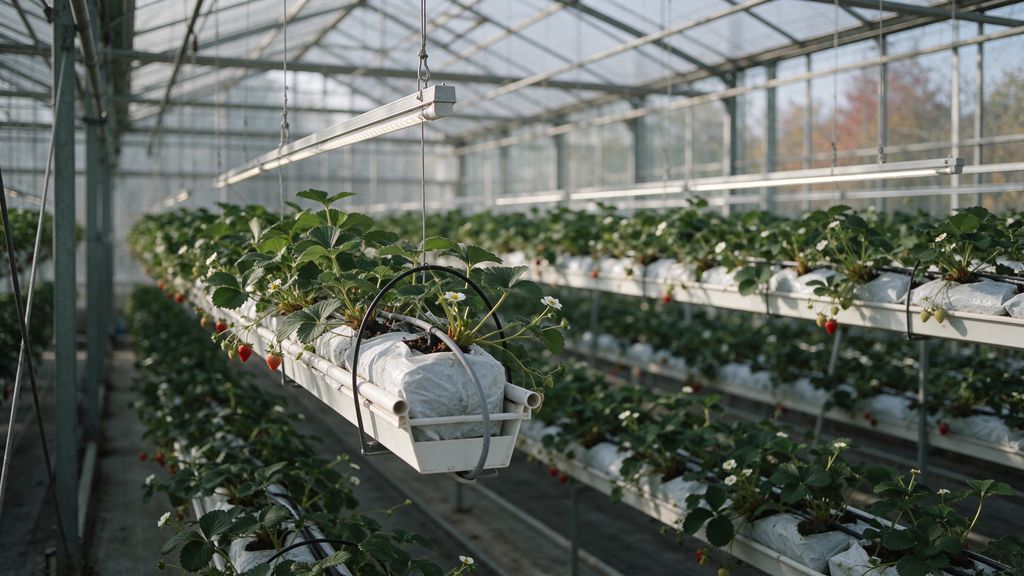
Elevated gutters put the canopy at a predictable height, so luminaire height and spacing can be tuned precisely and checked with a sensor grid.
How we would measure it
Agree the cultivar, program and success criteria (flowering date, runner count, yield per plant) before installation.
Install on a few test benches with untreated control benches, separated so that stray light stays below a stated limit.
Measure red and far-red irradiance at plant height on a grid at night, and log switching times.
Record crop responses weekly and decide on scaling only from the measured difference.
Where light pays, and where it does not
Photoperiod lighting uses little power, so it can pay back through a modest change in timing or flowering, if the cultivar responds. That has not yet been shown in a Turkish trial, which is why our offer there is a measured pilot. Photosynthetic toplighting for strawberries pays only in markets that reward winter fruit at high prices and in well-insulated, heated greenhouses; in Canada it is established at a few named sites, while a fully indoor vertical strawberry farm has not yet shown a durable business case.
Canada and Türkiye
Canada: greenhouse strawberry production grew sharply between 2020 and 2025 and lit winter production exists in Ontario, Alberta and Québec. Türkiye: protected strawberries are concentrated in Mersin, Aydın and Antalya, almost all unlit; photoperiod lighting is untested there, and that is the gap a pilot would close.
Evidence and sources (21)
- Ohio State Univ., OHCEAC. Controlled Environment Berry Production Information — Photosynthetic Lighting. ohceac.osu.edu
- Ohio State Univ., OHCEAC. Controlled Environment Berry Production Information — Photoperiodic Lighting. ohceac.osu.edu
- Ibaraki Prefectural Agricultural Center, Horticultural Research Institute (2014, H26 results). Fluorescent and LED lamps can replace incandescent lamps in strawberry electric-lighting culture ('Tochiotome'). pref.ibaraki.jp
- Fukushima Agricultural Technology Centre (Kobayashi, T.; research 2013-2014). Long-duration electric lighting of strawberry with red LEDs ('Tochiotome'). pref.fukushima.lg.jp
- Lin, Y., Barker, D.J., Kubota, C. (2025). Supplemental far-red light prevents semidormancy of short-day strawberry in indoor production. HortTechnology 35(5):663. journals.ashs.org
- Kubota, C., Lin, Y., Tripathi, P. (American Floral Endowment) (2025-12-01). Dormancy management for maintaining productivity in winter crop production. HortiDaily. hortidaily.com
- Van Delm, T., Melis, P., Stoffels, K., Vanderbruggen, R., Baets, W. (2016). Advancing the strawberry season in Belgian glasshouses with supplemental assimilation lighting. Acta Hortic. 1134:147-154. doi:10.17660/ActaHortic.2016.1134.20 ishs.org
- HortiDaily (2022-05-20). Signify's LED with far-red light performs well in strawberry cultivation (Belgian growers Fresa and Fragaria). hortidaily.com
- HortiDaily (2021-05-25). Dutchberries growing with full LED in new greenhouse. hortidaily.com
- Stadler, C. (2023). What must be considered in winter strawberry production under LEDs in Iceland? Acta Agric. Scand. B 73(1):152-160. doi:10.1080/09064710.2023.2251498 (+ LbhÍ project report). lbhi.is
- Kaiser, E., Janse, J. (2016). Consultancy genereren basiskennis fotosynthese aardbei. WUR report GTB-1411. edepot.wur.nl
- Park, Y., Sethi, R., Temnyk, S. (2023). Growth, flowering, and fruit production of strawberry 'Albion' in response to photoperiod and photosynthetic photon flux density of sole-source lighting. Plants 12(4):731. doi:10.3390/plants12040731 mdpi.com
- Hytönen, T., Kurokura, T. (2020). Control of flowering and runnering in strawberry. Hort. J. 89(2):96-107. doi:10.2503/hortj.UTD-R011 jstage.jst.go.jp
- Dieleman, A., de Gelder, A., Weerheim, K., et al. (2020). Naar een effectief gebruik van LED belichting in de glastuinbouw — Denkkader licht. WUR report WPR-774. doi:10.18174/526138 edepot.wur.nl
- Purdue University, Gómez lab (2025). Effect of photosynthetic photon flux density on strawberry runner tips propagated indoors. HortScience 60(4):631. doi:10.21273/HORTSCI18388-24 journals.ashs.org
- Zheng, J. et al. (2019). Effect of light intensity on rooting and growth of hydroponic strawberry runner plants in a LED plant factory. Agronomy 9(12):875. doi:10.3390/agronomy9120875 mdpi.com
- Okayama University, Scientific Reports of the Faculty of Agriculture 112 (night-break vs day-extension lighting of strawberry). ousar.lib.okayama-u.ac.jp
- Onofre, R.B. et al. (2021). Use of ultraviolet light to suppress powdery mildew in strawberry fruit production fields. Plant Disease 105(9). scholars.mssm.edu
- Marcelis, L.F.M., Broekhuijsen, A.G.M., Meinen, E., Nijs, E.M.F.M., Raaphorst, M.G.M. (2006). Quantification of the growth response to light quantity of greenhouse grown crops. Acta Hortic. 711:97-104. ishs.org
- Sheibani, F., Bourget, M., Morrow, R.C., Mitchell, C.A. (2023). Close-canopy lighting, an effective energy-saving strategy for overhead sole-source LED lighting in indoor farming. Front. Plant Sci. 14:1215919. doi:10.3389/fpls.2023.1215919 frontiersin.org
- NASA POWER Climatology API v2.10.2 (SYN1DEG, 2001-2025), ALLSKY_SFC_SW_DWN in MJ/m²/day — project files docs/research/nasa-power/*.json. power.larc.nasa.gov
Figures are calculated or taken from published sources. Nothing on this page is a measured result of a WONE installation.
Tell us about the crop and the space.
The crop, the location, the structure and what is already installed are enough to start. We reply with the questions that decide the lighting design and an outline of the measurements we would take.