
- Home
- Applications
- Raspberries & blueberries
Application · Berries
Raspberries and blueberries: a narrow case for light.
Most berries in Canada are field crops, and they will stay that way. Lighting enters the picture under protection, in propagation, and in research. This page is short because the honest case is narrow.
Where light can apply
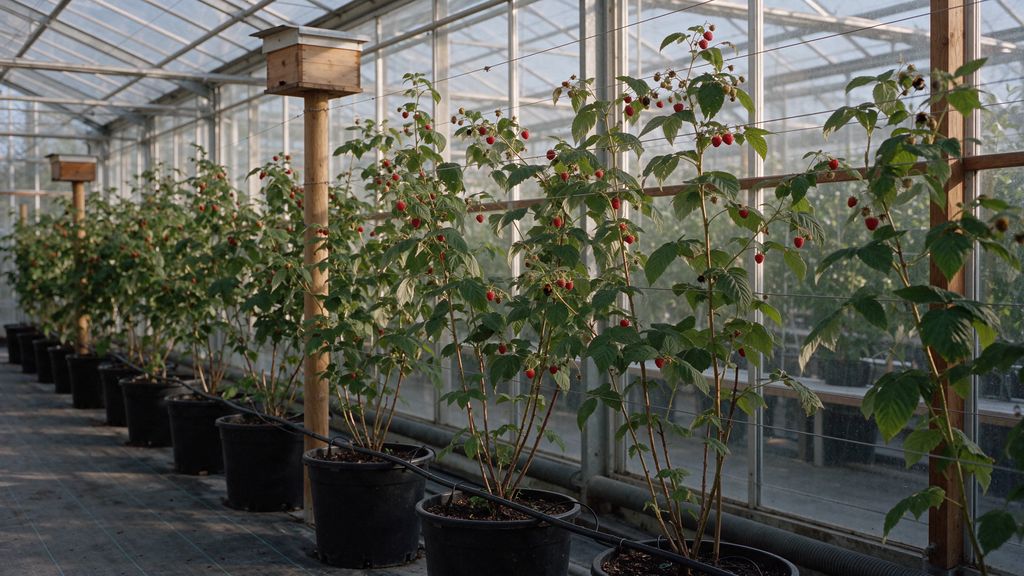
Long-cane raspberries grown in pots under glass are produced out of season in some countries, and supplemental light is used experimentally to support winter or early-spring crops.
Propagation of berry plants (raspberry canes, blueberry cuttings, haskap and saskatoon nursery stock) can benefit from controlled light in nurseries.
Field blueberries, cranberries and wild blueberries are not candidates for artificial lighting at production scale.
Values are ranges reported in the sources listed. Cultivar, climate, stage and production goal move them; a project starts by agreeing the target for that crop.
Experimental, not established
Lit raspberry production is experimental in Canada. We would treat any project as a research pilot with clear measurements.
Chilling and dormancy
Cane fruit and blueberries need chilling. Light cannot replace it, and programs must respect the plant’s dormancy cycle.
How we would measure it
Canopy PPFD and DLI during the lit period.
Flowering and harvest timing against unlit plants.
Energy per kilogram of fruit.
Where light pays, and where it does not
For field berries, full-cycle artificial light is economically weak. For protected raspberries the case is unproven and depends on winter prices; for propagation it depends on plant value and speed.
Canada and Türkiye
Canada: raspberries are mainly in British Columbia’s Fraser Valley; highbush blueberries in British Columbia; wild blueberries and cranberries in Québec and the Atlantic provinces. Türkiye: not part of our current screening beyond strawberries.
Evidence and sources (5)
- Janse, J., Streminska, M., Weerheim, K., Leiss, K., van Twist, T., Huisman, H.M. (2023). LED-belichting in een winterteelt met braam en framboos 2018-2019. WUR report WPR-1219. doi:10.18174/631355 edepot.wur.nl
- Janse, J., van Klink, A., Weerheim, K., de Jager, D., Raaphorst, M. (2022). Efficiënte jaarrondteelt van bramen met LED. WUR report WPR-1159. doi:10.18174/572234 edepot.wur.nl
- Ohishi-Yamazaki, M., Watanabe, M., Nakanishi, A., Che, J., Horiuchi, N., Ogiwara, I. (2018). Shortening of the juvenile phase of the southern highbush blueberry grown in controlled rooms under artificial light. Hort. J. 87(3):329-339. doi:10.2503/hortj.OKD-136 jstage.jst.go.jp
- Proceedings of the Florida State Horticultural Society 125 (2012). Night-interruption lighting of container blueberry (25 Sep-15 Nov 2011) delayed flowering 4-5 weeks. journals.flvc.org
- Pesquisa Agropecuária Brasileira (2024). In vitro rhizogenesis of blueberry microcuttings under different LED light spectra. scielo.br
Figures are calculated or taken from published sources. Nothing on this page is a measured result of a WONE installation.
Tell us about the crop and the space.
The crop, the location, the structure and what is already installed are enough to start. We reply with the questions that decide the lighting design and an outline of the measurements we would take.