
- Home
- Applications
- Dragon fruit
Application · Dragon fruit (Türkiye)
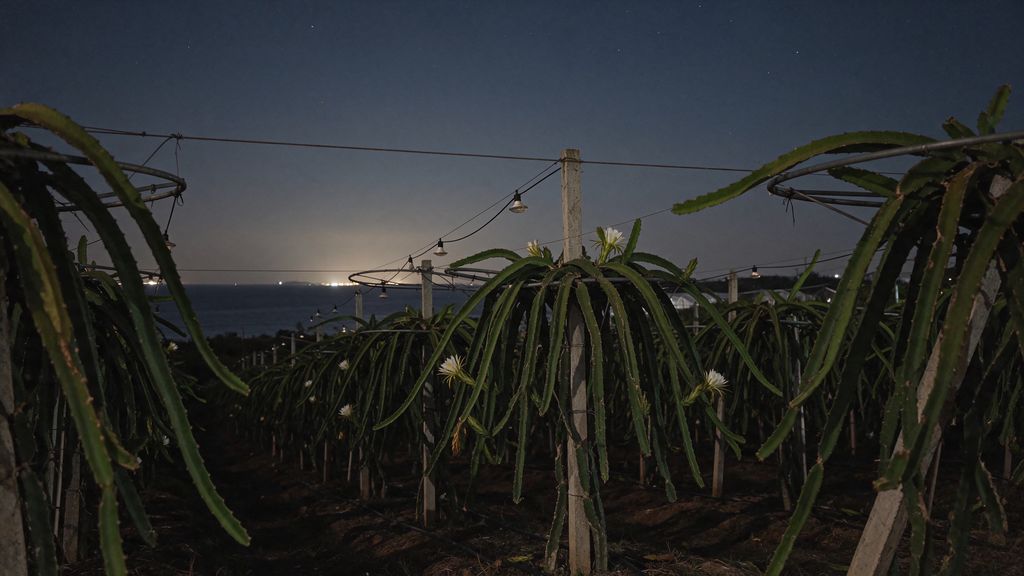
Dragon fruit: light at night to move the season.
Pitaya flowers when nights are short. Lighting the plants for a few hours in the middle of long autumn and winter nights can trigger flowering outside the natural season. It is a photoperiod signal, delivered at very low intensity, and it has nothing to do with photosynthesis.
What light does for this crop
Night-break lighting interrupts the long night so the plant reads a short one. Studies in Taiwan, Vietnam and China report off-season flowering under night-break lighting with incandescent lamps or LEDs.
Intensity is low. The goal is a signal, measured in a few µmol/m²/s (or tens of lux in older studies), delivered evenly to all stems. Daily light integral is not the target.
Timing matters. Start date, duration of the night break and the number of nights decide the response, together with temperature, which also limits flowering in cool winters.
- Working threshold at plant level
- ≥ 1 µmol/m²/s1–3 µmol/m²/s · red + far-red
- Night break
- 4 h per night
Values are ranges reported in the sources listed. Cultivar, climate, stage and production goal move them; a project starts by agreeing the target for that crop.
Try the model
Rows of post-trained pitaya with lamps along each row. Change lamp spacing and height and check whether every plant receives the working threshold during the night break.
- Jiang, Y.L., Liao, Y.Y., Lin, T.S., Lee, C.L., Yen, C.R., et al. (2012). The photoperiod-regulated bud formation of red pitaya (Hylocereus sp.). HortScience 47(8):1063-1067. doi:10.21273/HORTSCI.47.8.1063 doi.org
- Nguyen, Q.T., Ngo, M.D., Truong, T.H., Nguyen, D.C., Nguyen, M.C. (2021). Modified compact fluorescent lamps improve light-induced off-season floral stimulation in dragon fruit farming. Food Sci. Nutr. 9(5):2390-2401. doi:10.1002/fsn3.2088 doi.org
- Xiong, R., Liu, C., Xu, M., Wei, S.-S., Huang, J.-Q., Tang, H. (2020). Transcriptomic analysis of flower induction for long-day pitaya by supplementary lighting in short-day winter season. BMC Genomics 21:329. doi:10.1186/s12864-020-6726-6 doi.org
- Chen, R., Ding, Y., Liu, W., et al. (2025). Physiological effects and technical strategies of LED supplemental lighting for pitaya cultivation: a review. PeerJ 13:e19720. doi:10.7717/peerj.19720 peerj.com
- Chu, Y.C., Chang, J.C. (2020). Regulation of floral bud development and emergence by ambient temperature under a long-day photoperiod in white-fleshed pitaya (Hylocereus undatus). Sci. Hortic. 271:109479. peerj.com
- Khaimov, A., Mizrahi, Y. (2006). Day-length, radiation, flower thinning and growth regulator effects on flowering of vine cacti (Israel), as cited in a Hylocereus review. dialnet.unirioja.es
- UNEP. Viet Nam dragon fruit orchards bloom in new light. unep.org
- Nhân Dân. Binh Thuan applies lighting technology to increase crop productivity. en.nhandan.vn
- Vietnam Academy of Agricultural Sciences journal. Xây dựng quy trình chiếu sáng thích hợp của đèn compact chuyên dụng điều khiển ra hoa cho thanh long. tapchi.vaas.vn
- Sözcü. Ege'de ilk kez yapıldı: sadece 4 saat yetiyor (Aydın-Nazilli pitaya LED greenhouse). sozcu.com.tr
- HortiDaily. Citrus fruit production fields converted into dragonfruit greenhouses in Antalya. hortidaily.com
- Forsythe, W.C., Rykiel, E.J., Stahl, R.S., Wu, H., Schoolfield, R.M. (1995). A model comparison for daylength as a function of latitude and day of year. Ecol. Model. 80:87-95. doi:10.1016/0304-3800(94)00034-F doi.org
Evenness, not power
Plants between lamps receive the least light. The lowest value on the crop decides the design.
Lux in older studies
Many pitaya studies report illuminance in lux. We convert using the modelled spectrum of the lamp and show both numbers, so they can be compared honestly.
Outdoor hardware
Field and tunnel installations face rain, dust and sun. Protection, cabling and safety are part of the design, not an afterthought.
Temperature can veto the light
Studies report that induced flowering needs warm nights, around 15 °C or more; one study saw no flowering at 27/17 °C day/night, and trials in Israel found no lighting effect at all. On Türkiye’s coast, mid-winter induction may therefore need heating. A pilot records night temperature next to the light.
How we would measure it
Measure irradiance (and illuminance for comparison) at stem height between and under lamps.
Lit and unlit rows, separated so that stray light on the control rows stays below a stated limit.
Record flower buds, flowering dates and fruit set per row, with night temperatures.
Where light pays, and where it does not
Off-season fruit can command higher prices, and the electrical load is small. The question is whether the response is reliable in Türkiye’s climate. One commercial greenhouse in Aydın is reported to use LED night lighting; no Turkish trial has been published. This is a pilot application, and we treat it as one.
Canada and Türkiye
Türkiye: dragon fruit is grown in small areas on the Mediterranean and Aegean coasts, in greenhouses and in the open. Canada: not a production crop.
Evidence and sources (12)
- Jiang, Y.L., Liao, Y.Y., Lin, T.S., Lee, C.L., Yen, C.R., et al. (2012). The photoperiod-regulated bud formation of red pitaya (Hylocereus sp.). HortScience 47(8):1063-1067. doi:10.21273/HORTSCI.47.8.1063 doi.org
- Nguyen, Q.T., Ngo, M.D., Truong, T.H., Nguyen, D.C., Nguyen, M.C. (2021). Modified compact fluorescent lamps improve light-induced off-season floral stimulation in dragon fruit farming. Food Sci. Nutr. 9(5):2390-2401. doi:10.1002/fsn3.2088 doi.org
- Xiong, R., Liu, C., Xu, M., Wei, S.-S., Huang, J.-Q., Tang, H. (2020). Transcriptomic analysis of flower induction for long-day pitaya by supplementary lighting in short-day winter season. BMC Genomics 21:329. doi:10.1186/s12864-020-6726-6 doi.org
- Chen, R., Ding, Y., Liu, W., et al. (2025). Physiological effects and technical strategies of LED supplemental lighting for pitaya cultivation: a review. PeerJ 13:e19720. doi:10.7717/peerj.19720 peerj.com
- Chu, Y.C., Chang, J.C. (2020). Regulation of floral bud development and emergence by ambient temperature under a long-day photoperiod in white-fleshed pitaya (Hylocereus undatus). Sci. Hortic. 271:109479. peerj.com
- Khaimov, A., Mizrahi, Y. (2006). Day-length, radiation, flower thinning and growth regulator effects on flowering of vine cacti (Israel), as cited in a Hylocereus review. dialnet.unirioja.es
- UNEP. Viet Nam dragon fruit orchards bloom in new light. unep.org
- Nhân Dân. Binh Thuan applies lighting technology to increase crop productivity. en.nhandan.vn
- Vietnam Academy of Agricultural Sciences journal. Xây dựng quy trình chiếu sáng thích hợp của đèn compact chuyên dụng điều khiển ra hoa cho thanh long. tapchi.vaas.vn
- Sözcü. Ege'de ilk kez yapıldı: sadece 4 saat yetiyor (Aydın-Nazilli pitaya LED greenhouse). sozcu.com.tr
- HortiDaily. Citrus fruit production fields converted into dragonfruit greenhouses in Antalya. hortidaily.com
- Forsythe, W.C., Rykiel, E.J., Stahl, R.S., Wu, H., Schoolfield, R.M. (1995). A model comparison for daylength as a function of latitude and day of year. Ecol. Model. 80:87-95. doi:10.1016/0304-3800(94)00034-F doi.org
Figures are calculated or taken from published sources. Nothing on this page is a measured result of a WONE installation.
Tell us about the crop and the space.
The crop, the location, the structure and what is already installed are enough to start. We reply with the questions that decide the lighting design and an outline of the measurements we would take.