
- Home
- Solutions
Solutions
Design, measurement and integration first. Hardware where it is justified.
Most lighting decisions in a greenhouse are made before a fixture is chosen. We work on those decisions, with whichever luminaires suit the crop.
What we do
Five kinds of work.
Lighting studies and simulation
Crop targets, natural-light analysis by month, luminaire options, layout, schedule and energy, compared side by side. Delivered as a written study and an interactive model of the growing space.
Measurement and verification
PPFD grids and spectral checks at canopy height, before and after changes, with the method and instruments stated. We compare the result with the calculation and explain the difference.
Controls and schedule concepts
Zoning, dimming and switching programs, including lighting only when natural light falls short of the target. Concepts are worked out with the grower’s climate-computer supplier.
Integration of partner luminaires
Where certified luminaires already exist for a crop, especially high-power toplights, we design around them instead of developing our own. Installation is carried out by licensed electrical contractors.
Pilot studies
Small, measured trials with control areas and success criteria agreed in advance, so a grower can decide on scaling from data rather than from a brochure.
For projects in Canada we provide lighting studies, simulations, measurement plans and control concepts for discussion. We do not offer installation, and work that requires a licensed professional engineer in a province is not offered by WONE.
Product development
Our own luminaires, shown at their real stage.
We develop hardware only where existing products do not fit the job: low-power photoperiod lighting and propagation lighting. Each line carries its status on this scale.
- Concept
- Engineering development
- Prototype
- Laboratory measured
- Field validated
- Commercially available
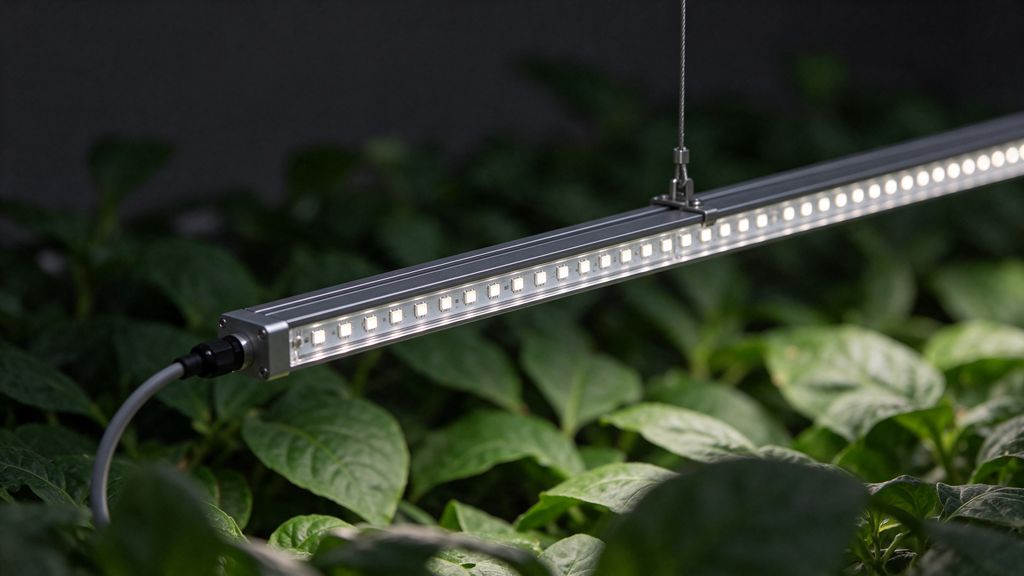
Linear photoperiod luminaire, 120 cm
Two independently switched channels, deep red (660 nm) and far-red (730 nm), for night-interruption and day-extension programs in strawberries, dragon fruit and other photoperiod-sensitive crops. The circuit boards are designed; no unit has been built or measured yet.
In engineering development. Not certified, and not offered for sale in Canada. In Canada a luminaire can be sold and installed only after an accredited certification body has certified it.
Calculated design targets (not measured)
| Length | 120 cm |
|---|---|
| Electrical input | about 34 W |
| PAR photon flux, 400–700 nm | about 65 µmol/s |
| Far-red photon flux, 700–780 nm | about 42 µmol/s |
Calculated from component data. These values will be replaced by measured values after laboratory testing. Intended for horticultural use only.
Propagation and rack lighting bar
A broad-spectrum bar for seedling racks and multilayer propagation. Concept stage: no specifications are published yet.
How a project runs
From a first conversation to measured results.
Conversation
Crop, cultivar, structure, location, current lighting and goal.
Study
Targets, natural light, options and a model the grower can explore.
Pilot or retrofit
A measured trial or a staged change, with controls and success criteria.
Verification
Measurements, comparison with the design, and a record of what was delivered.
Tell us about the crop and the space.
The crop, the location, the structure and what is already installed are enough to start. We reply with the questions that decide the lighting design and an outline of the measurements we would take.